

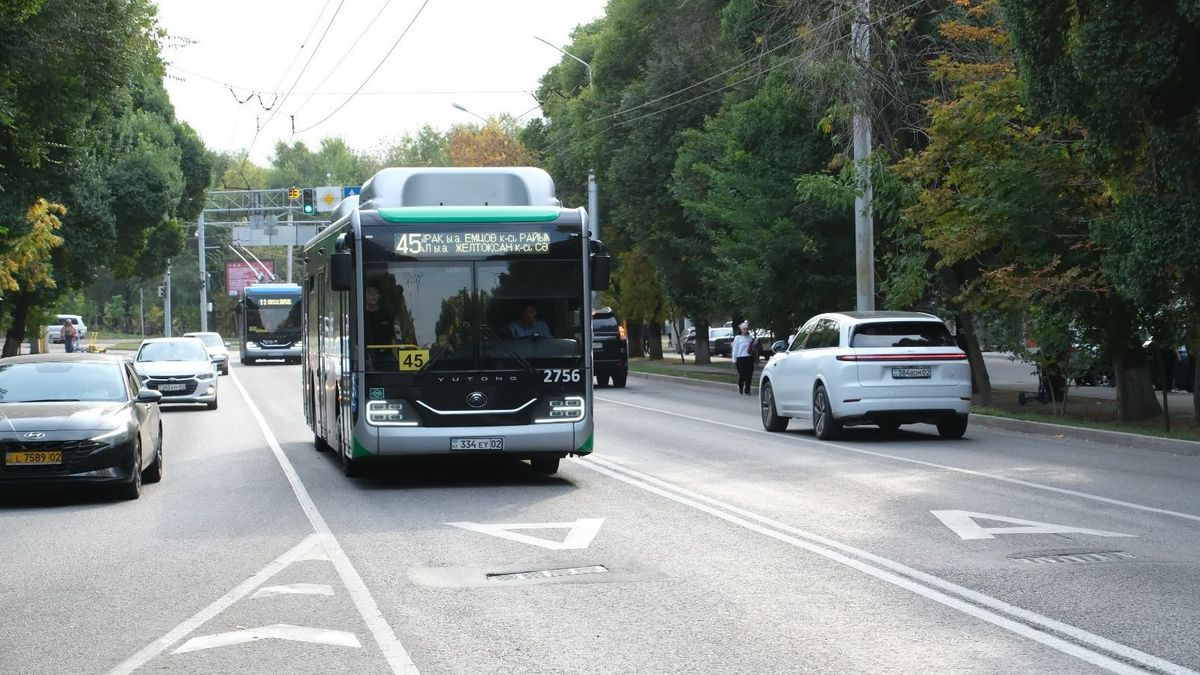
In Almaty, the pilot project for a dedicated public transport lane on Sain Street has concluded, reports infohub.kz.
The city's akimat has summarized the results of the experiment and stated that it confirmed the effectiveness of prioritizing public transport. However, further development of dedicated lanes will proceed within a unified comprehensive scheme, rather than as isolated segments.
According to the Department of Traffic Management and Passenger Transport, the introduction of the dedicated lane on Sain Street led to positive trends in key public transport performance indicators. The most noticeable effect was observed during peak hours.
During the morning rush hour, the average speed of public transport on the stretches increased from 26.2 to 31.8 km/h, a gain of 5.6%. In the evening rush hour, the average speed rose from 25.0 to 30.4 km/h, an increase of 5.4%.
Service regularity also improved: the average interval over the full day dropped from 13.6 to 12 minutes, nearly 12%, and during the morning rush hour from 13.6 to 11.6 minutes, or 14.7%.
Passenger traffic also showed growth: the number of passengers per day increased from 42,396 to 44,515.8, or 5%.
The akimat explained that the pilot results confirmed the effectiveness of the dedicated lane as a tool for increasing the speed and regularity of public transport, especially during peak hours. However, the pilot highlighted the need to develop dedicated lanes not as isolated segments but as an interconnected system that ensures priority for public transport on key city thoroughfares.
In this regard, Sain Street is considered part of a comprehensive scheme that includes a circular route along Al-Farabi Avenue, Sain Street, Ryskulov Avenue, and the Eastern Bypass Road, where public transport will be given priority.
Starting August 31, the dedicated lane on Sain Street will be removed. This is due to the transition from the pilot format to the next stage: preparing other sections of the network and the necessary regulatory conditions for implementing the comprehensive scheme.
To achieve this, other sections of the network must be prepared in stages, and amendments to existing standards and regulatory documents of the Republic of Kazakhstan in the field of traffic management are required. After the necessary regulatory decisions and corresponding infrastructure are in place, priority movement on Sain Street is planned to be implemented as part of the comprehensive scheme, ensuring interconnected operation of dedicated lanes on key city thoroughfares.