

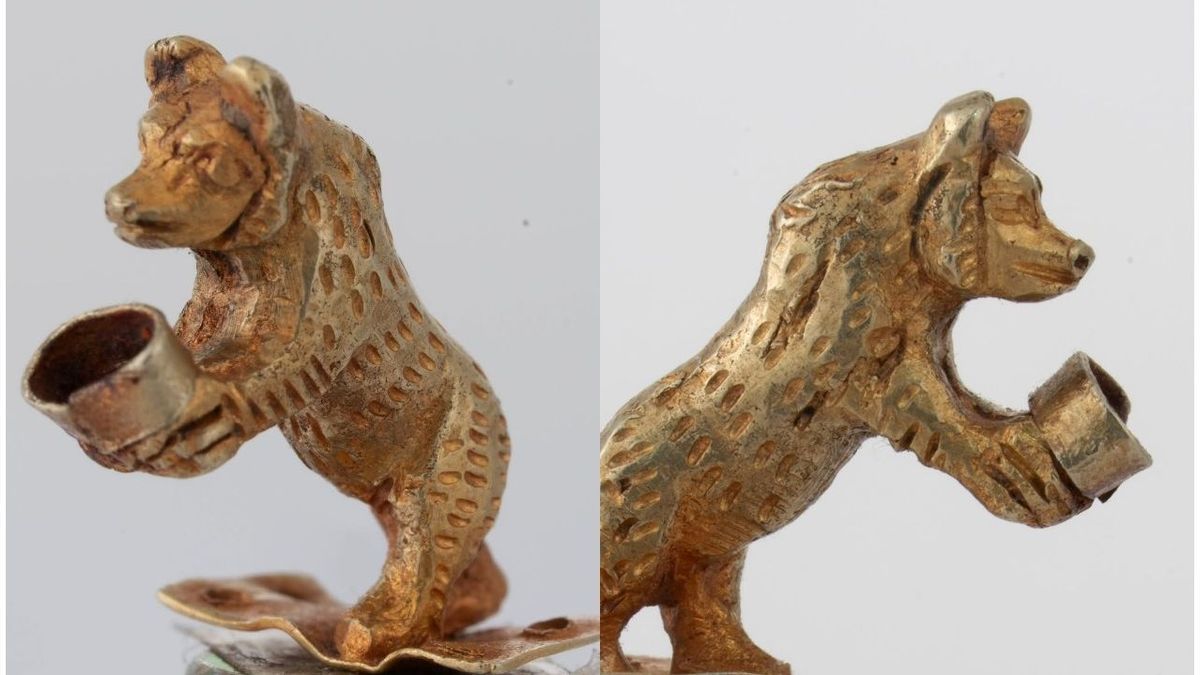
Archaeologists have discovered a gold ornament from the Saka era — believed to be a cast figurine of a bear that served as an element of a headdress — at the Karagaily burial ground in Almaty's Nauryzbai district, the website infohub.kz reports.
According to the city akimat, the artifacts were found during emergency archaeological excavations of a Saka-period kurgan dating to the early Iron Age. Besides the gold item, researchers found human remains.
"The diameter of the kurgan is 25-26 meters, and its height is about 2.5 meters. Based on a preliminary dating from study of the burial ground, the site belongs to the Saka period and dates to the 4th-3rd centuries BC. The kurgan was looted in antiquity. The looters' pit is 3 meters deep," the akimat's statement said.
During the excavations, archaeologists found a significant number of human remains. It is believed that four adults and three children may have been buried in the kurgan. The exact number of those buried has not yet been established.
In addition to the bone remains, fragments of Saka ceramics were found. Most of the artifacts were scattered haphazardly after the looting. Of particular value is a unique gold item — believed to be a small cast gold figurine in the shape of a bear, intended to decorate a headdress. The presence of holes in the plate indicates that the ornament could have been sewn onto a headdress.
According to the akimat, such items are characteristic of Saka-era costume. For example, a gold finial in the shape of an argali was found on the headdress of the "Golden Man," and in 2014 a figurine of a snow leopard, also an element of a headdress, was found at the Kok-Kainar burial ground.
"Research at the Karagaily burial ground continues. To clarify the circumstances of the burial and determine the exact number of those buried, additional analyses are planned, including with the involvement of anthropologists. Of particular interest is the unusually large number of human remains in a single kurgan, since such burials are atypical for Kazakhstan. As a rule, kurgans of comparable size were intended for the burial of one or two people," said Marat Nurpeisov, a senior researcher at the Almaty City Museums Association.
As for the bear figurine, specialists noted that it is unique for our country. Such a find makes it possible to trace cultural parallels across the entire expanse of Eurasia from the Black Sea region to the Altai, said Lyazzat Sagyndykova, director of the Almaty City Museums Association.
After the full archaeological research is completed and the necessary scientific processing of the discovered materials is carried out, the most valuable artifacts are planned to be included in the exhibition of the Almaty museum and presented to the general public.