

In the first half of 2026, Almaty became Kazakhstan's largest center for motor vehicle production, with output valued at 488.2 billion tenge, accounting for 42.3% of the national total. Together with the Kostanay Region (438.7 billion tenge, 38%), the two regions account for over 80% of all vehicle, trailer, and semi-trailer production, according to infohub.kz.
Third place is held by the Karaganda Region with 110.9 billion tenge (9.6%), followed by the Abai Region (56.3 billion tenge) and the Akmola Region (43.2 billion tenge). Collectively, these five regions account for 98.6% of the country's automotive production. Volumes in other regions are significantly lower: Astana – 11.2 billion tenge, West Kazakhstan Region – 2.7 billion tenge, and Pavlodar Region – 1.4 billion tenge.
The automotive industry plays a key role in the economies of the leading regions. In Almaty, it accounts for 82.9% of machinery manufacturing, 43.9% of the manufacturing industry, and 36.4% of total industrial output. In the Kostanay Region, the corresponding figures are 79.5%, 39%, and 27.9%. The automotive industry also makes a significant contribution to machinery manufacturing in the Abai Region (67.4%), Karaganda Region (36.4%), Akmola Region (27.7%), and West Kazakhstan Region (10.3%).
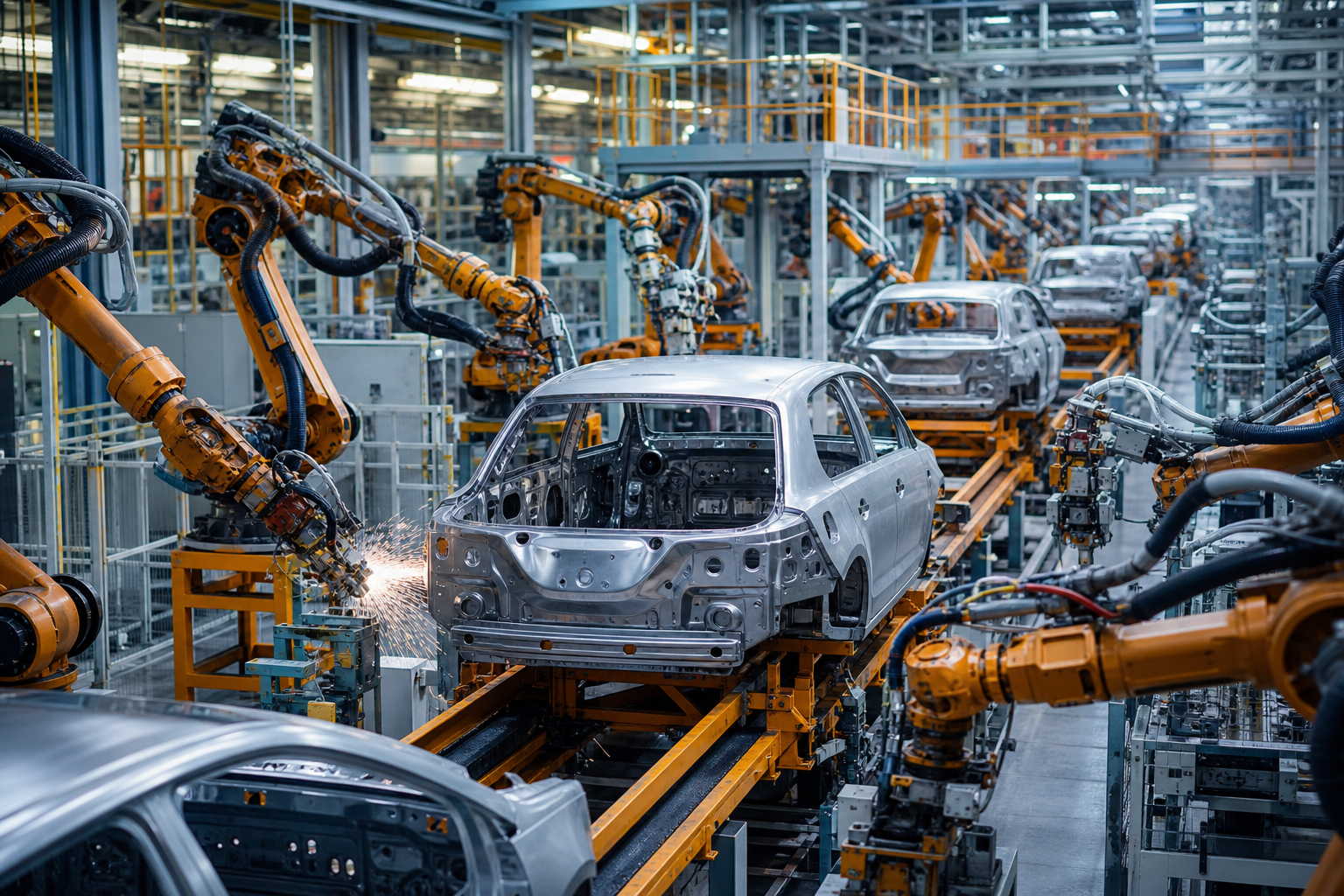
Kazakhstan has 11 enterprises producing passenger cars, trucks, buses, and special equipment. In 2025, the Astana Motors Manufacturing Kazakhstan and KIA Qazaqstan plants were launched, with total investments exceeding 346 billion tenge; their automated lines employ 119 industrial robots. The truck segment is also developing: in addition to Scania and Howo production, from the fourth quarter of 2026, 500 Volvo tractor units are planned to be produced annually at the Hyundai Trans Auto site. Barys Truck Manufactory, together with XCMG, is implementing a project to produce electric truck tractors.
Additional momentum is expected from agreements reached during the state visit of Kazakhstan's President Qasym-Jomart Toqaev to China. These include organizing the production of Li Auto, OMODA, and JAECOO vehicles, manufacturing SITRAK autonomous tractor units, and jointly with BYD developing a network of high-speed charging stations.
The development of machinery manufacturing remains a priority of state policy to diversify the economy. President Qasym-Jomart Toqaev has repeatedly emphasized the importance of creating modern production facilities and introducing advanced technologies, including autonomous vehicles and specialized automotive equipment. New investment projects are intended to strengthen Kazakhstan's position as one of the region's automotive manufacturing hubs.