

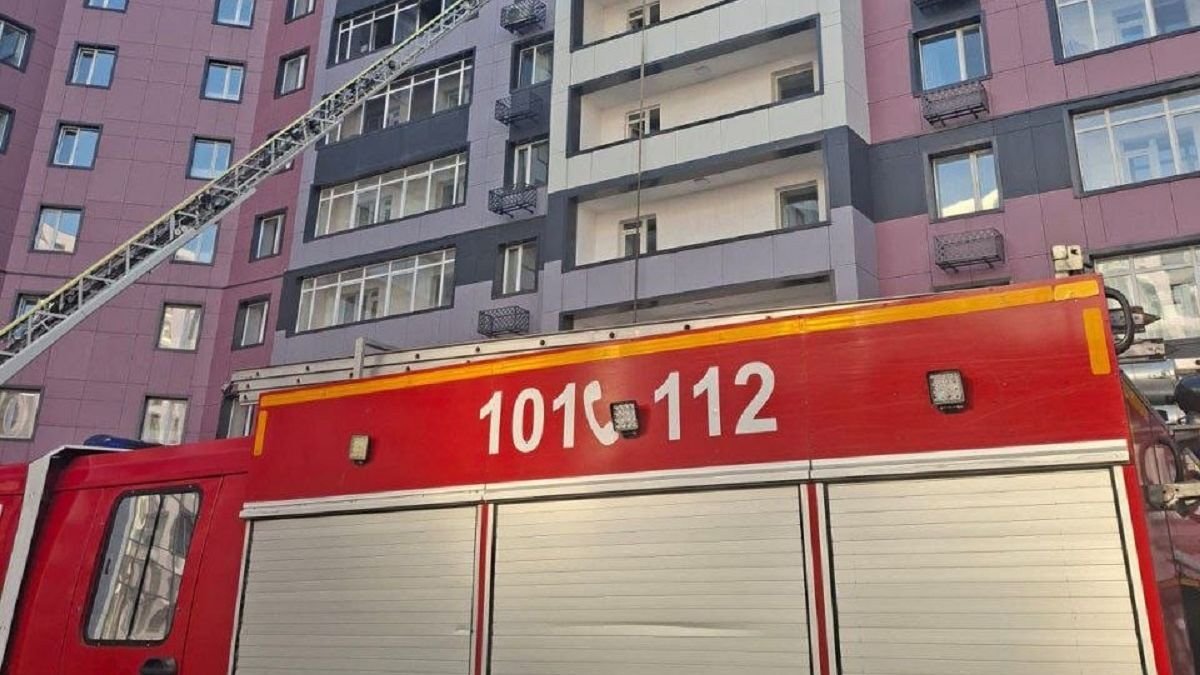
Changes have been made to the planning and development rules of Kazakhstan's capital regarding fire safety requirements for multi-storey residential complexes. The updated document was published on the official website of the Ministry of Industry and Construction of the Republic of Kazakhstan, as reported by infohub.kz, citing the Committee for Construction and Housing and Utilities.
Under the updated norms, apartment buildings with more than 200 units must have two separate access routes for fire equipment.
For multi-apartment residential complexes with up to 400 units, a single access route for fire equipment is permitted, but only if a number of conditions are met simultaneously. The height of a multi-apartment residential building combined with a stylobate (a shared base for several towers of a residential complex) must not exceed 50 metres. The floor corridors of the residential section must be equipped with a smoke exhaust ventilation system. Doors on evacuation routes must be fitted with magnetic contact sensors (SMK) that transmit information on their status (open/closed) to the fire post. A fire hydrant must be provided no more than 10 metres from the exit onto the stylobate. The turning radius of fire access roads must be at least 9.8 metres. The surface of the exit onto the stylobate must have an anti-slip coating and a heating system. The internal access route for fire equipment must allow for circular movement.
High-rise buildings with more than 400 units must be fully equipped with two separate access routes for fire equipment, regardless of the above technical solutions.
Recall that in the early hours of 12 April, a fire broke out in a 15th-floor apartment of a 21-storey residential building on Turkestan Street in the capital's Esil district. Twenty people were evacuated, but the bodies of three minor children were found in the apartment. In addition, one woman was hospitalised with burns.
Later, MP Olzhas Kuspekov proposed introducing fire lanes near buildings and allowing rescuers to remove and damage obstructing vehicles. After this proposal was made, the Ministry of Emergency Situations explained why firefighters in Astana did not ram the cars. It was stated that "the vehicle did not critically block the passage" and was removed as soon as possible.
At the same time, the Ministry of Emergency Situations issued a statement categorically opposing the MPs' initiative to allow rescuers to ram cars obstructing passage. It soon became known whether firefighters in Kazakhstan would be allowed to ram vehicles blocking passage.