

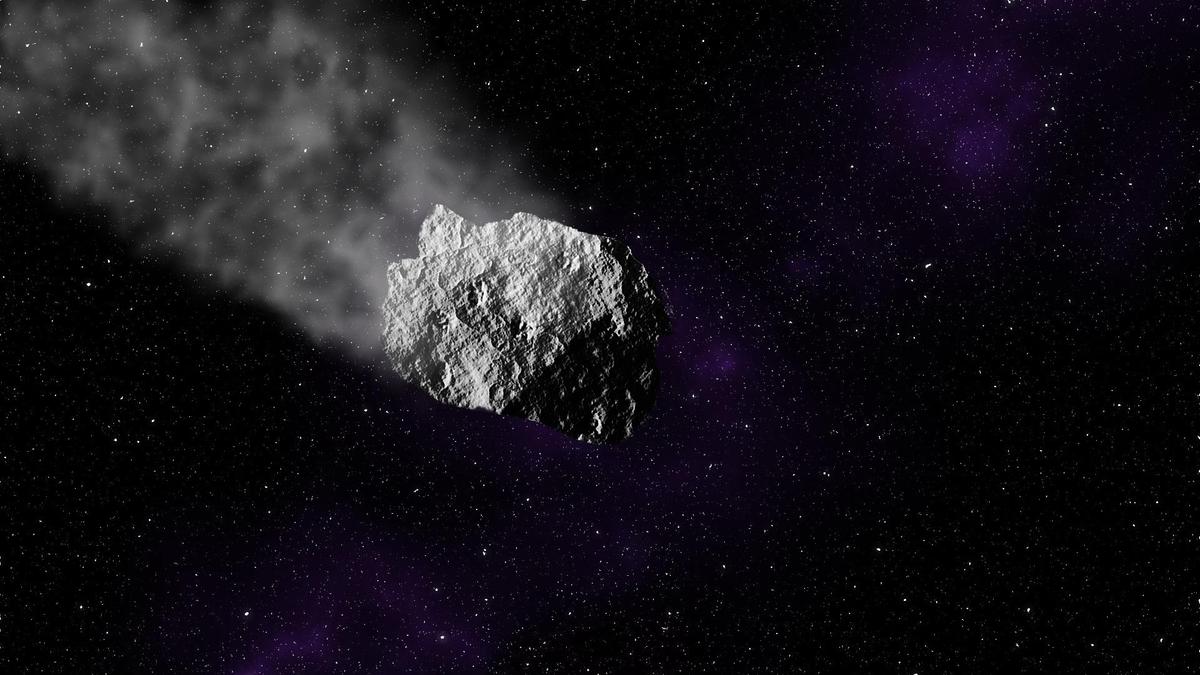
Choosing which side of an asteroid to detonate a nuclear device on can cut the effectiveness of deflecting it by nearly five times, because of the space rock's complex terrain, researchers at Sandia National Laboratories have found, as reported by ScienceDaily and the website infohub.kz.
A nuclear blast is currently considered one of the most promising methods of planetary defense. A powerful burst of X-ray radiation vaporizes part of the rock on the surface of a celestial body, creating thrust that should alter the trajectory of a hazardous object. However, in a study published in the journal Icarus, physicists have shown that an asteroid's shape can be the decisive factor between saving the planet and catastrophe. Unlike perfect spheres, real asteroids have complex terrain — depressions, ridges and asymmetric protrusions.
A team of physicists led by Nathan Moore built a computer model of asteroid deflection by combining the ALEGRA and SPARTA algorithms. The new software package runs 1,600 times faster than earlier analogues. It can load precise three-dimensional images of celestial bodies and calculate heat maps of material vaporization, momentum parameters, rock fracturing and the object's rotation. Previous models were too demanding on supercomputer capacity and did not account for surface irregularities.
The simulation demonstrated enormous sensitivity to the point of impact. When irradiated from one side, the asteroid's velocity changed by 3.9 millimeters per second, while a blast from another direction changed it by just 0.8 millimeters per second — a fivefold difference. The object's rotation rate varied by as much as 17 times when the angle of attack changed. In real conditions, an error in the calculations risks either insufficient orbital displacement or splitting the giant into dangerous fragments. For a successful mission, astronomers will need to obtain the body's detailed shape in advance and direct the charge with pinpoint accuracy.