

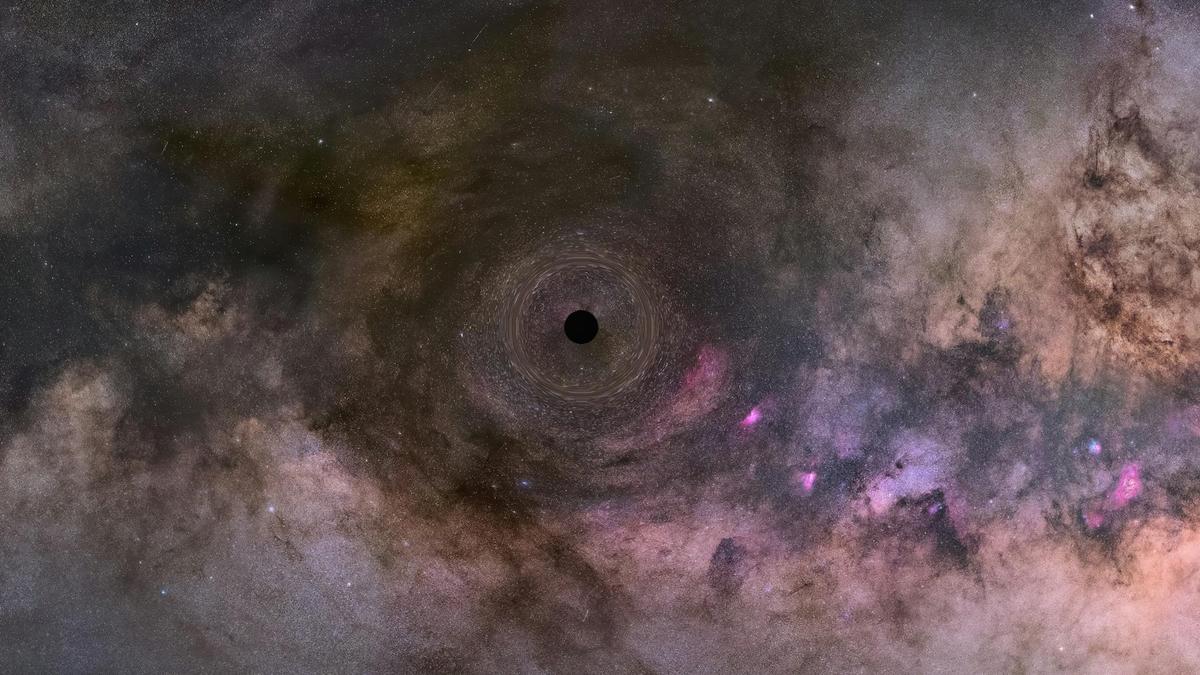
The James Webb Space Telescope has detected a unique anomalous object that emits 100 billion times more energy than a typical star due to a giant black hole inside, reports infohub.kz.
An international team of researchers from the Massachusetts Institute of Technology (MIT) has announced the discovery of a new type of astrophysical object. Using the James Webb Space Telescope, scientists spotted a bright red dot in the early universe, dubbed MoM-BH*-1.
The object is comparable in size to the Solar System, yet it produces 100 billion times more energy than any known star can physically generate. The team, led by Rohan Naidu, concluded they are observing a hybrid: a supermassive black hole with a mass of 100,000 Suns, encased in a dense cocoon of hydrogen and helium gas.
Spectral analysis revealed a deep Balmer break and the absence of dust or heavy metals, challenging standard hypotheses. Astronomers believe the discovery of the 'black hole star' could help solve the mystery of numerous 'little red dots' that regularly appear in images of the early cosmos and vanish by the present epoch.