

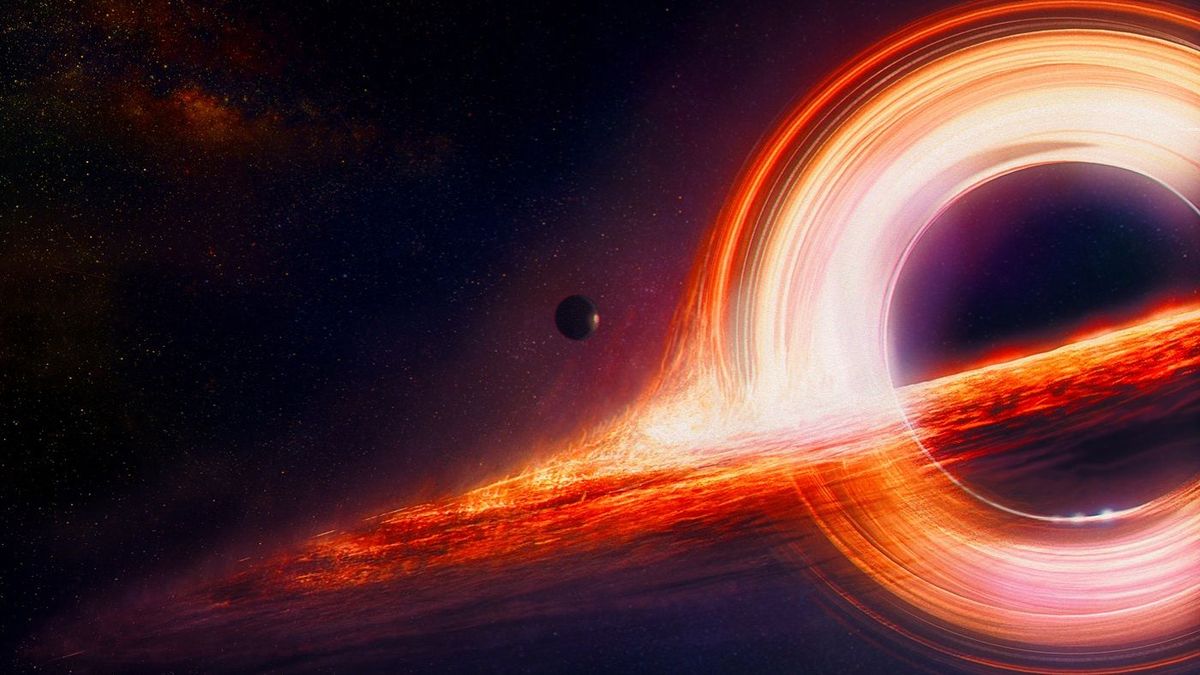
Scientists have figured out why repeated passages of stars near supermassive black holes become less bright, reports infohub.kz.
Astrophysicists from Syracuse University have found an explanation for the mysterious dimming of light flares that occur when stars repeatedly approach supermassive black holes. The results of their study were published in the scientific journal The Astrophysical Journal.
The research team, led by doctoral student Ananya Bandopadhyay with Eric Coughlin, studied partial tidal disruption events. Sometimes a star does not die immediately but remains in orbit around the black hole, losing mass with each close approach. However, in some systems, the flares from the disrupted material became progressively fainter, which had long been difficult to explain with computer models.
The scientists discovered that the key factor is the high spin rate of the star before it is captured by the black hole. Rapid rotation prevents the outflow of material from accelerating sharply during subsequent passes. As a result, the mass of ejected material decreases, and the intensity of the flares drops. The extremely fast rotation and close orbit are explained by the long-ago capture of the star from a binary system via the Hills mechanism.