

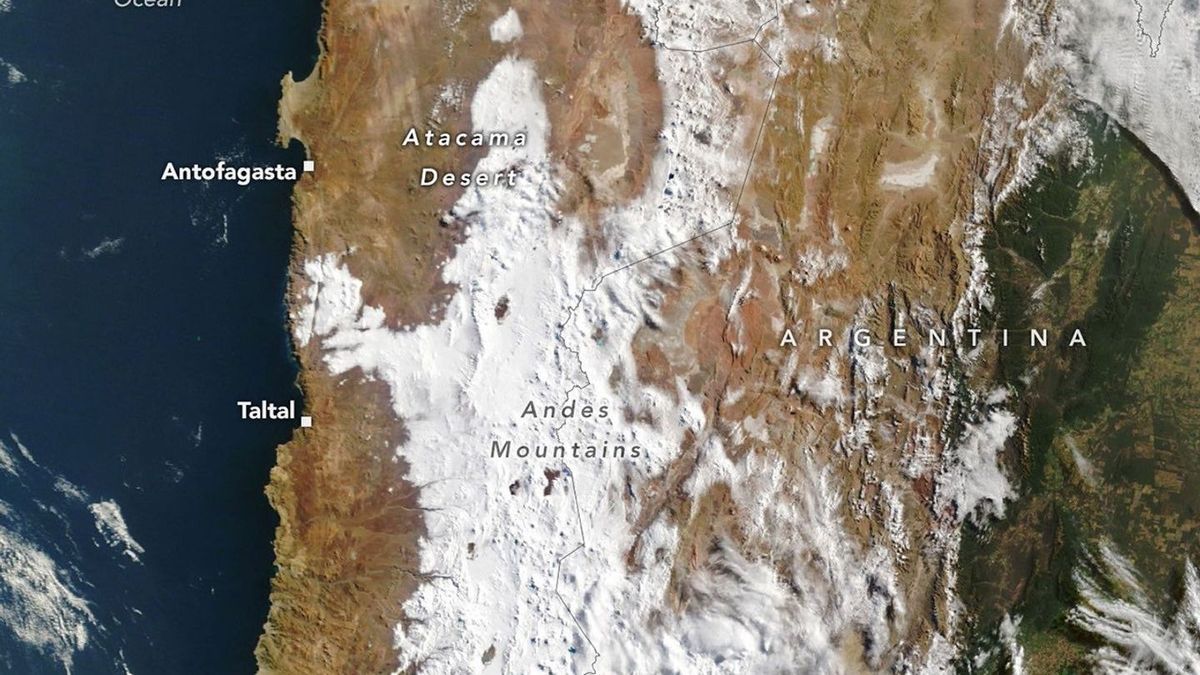
A series of powerful winter storms hit northern Chile, causing rare snowfall in the Atacama Desert. This is one of the driest places on the planet, where snow fell only in 2011 and 2025, but the current storm has amazed scientists with its scale, reports infohub.kz.
NASA and USGS satellites Landsat 8 and Landsat 9, equipped with OLI instruments, recorded dramatic changes in the terrain of the Chajnantor Plateau. Due to snowdrifts and strong winds, the ALMA radio telescope temporarily suspended operations and put its antennas into a protective mode. Later, NASA's Terra satellite observed new snowfall extending from the Andes across the desert center almost to the Pacific coast south of the city of Antofagasta.
Atmospheric scientist René Garreaud from the University of Chile explained that the cause was an isolated high-altitude cyclone. It broke off from a giant trough of low pressure stretching across the Southern Hemisphere. Combined with high humidity off the coast, the system produced unusual precipitation over a vast area.
On the coast, precipitation fell as heavy rain. In the town of Taltal, nearly 40 millimeters of rain fell in three days, about 10 times the average annual amount. Intense rains triggered mudslides and flash floods. According to the National Service for Disaster Prevention and Response (SENAPRED), thousands of residents were affected, and hundreds of homes suffered serious damage. Specialists attribute the main cause of the changing weather conditions to the intensifying El Niño phenomenon.