

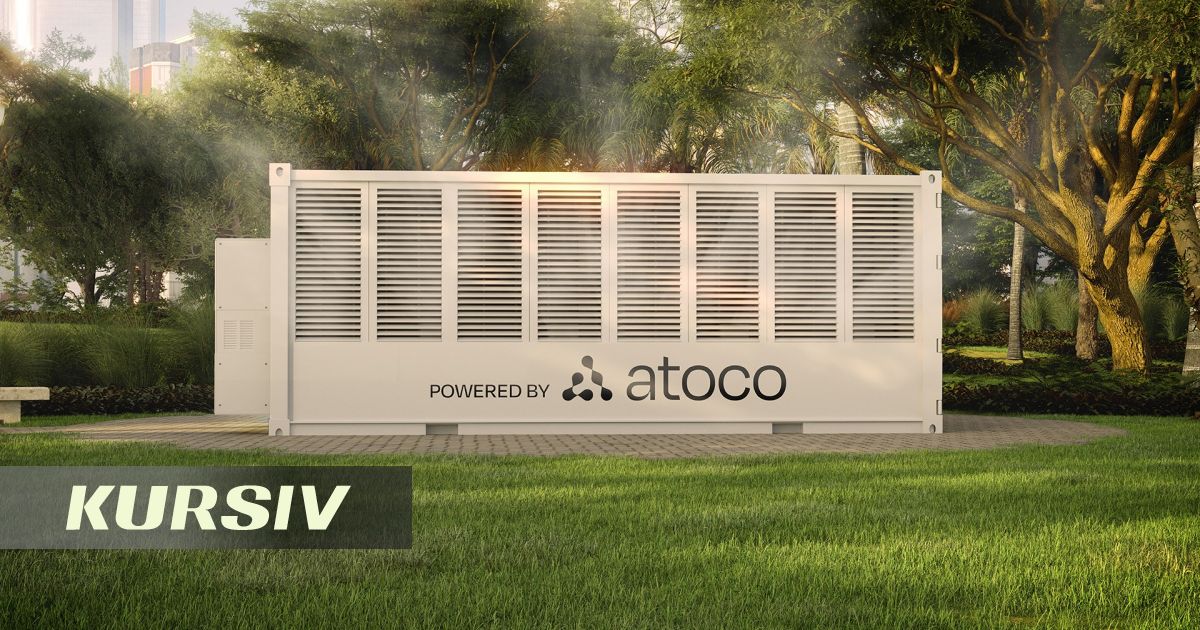
A California startup, Atoco, has built a device that extracts water directly from the air. The unit collects up to 300 liters a day even at humidity as low as 13%, and a small amount of heat is enough to release the moisture. The project was founded by chemist Omar Yaghi, who was awarded the Nobel Prize in 2025, according to infohub.kz.
The technology is based on metal-organic frameworks (MOFs). These porous materials act like a sponge, capturing water molecules from the air. Their internal surface area is so vast that the combined area of all the pores in a single gram of the material can reach that of two football fields.
Once the material has absorbed moisture, it is heated to about 38 °C. The water is released and can then be collected. A connection to the power grid is not required: heat left over from industrial equipment, for example, will do.
A test unit about six meters tall was installed in the parking lot of Atoco's office in Irvine, California. It can produce up to 300 liters of water a day. During the demonstration, the air temperature exceeded 32 °C, yet the unit ran almost silently. A solar panel powered the auxiliary electronics, while a heat source at about 66 °C was used for heating.
In quality, the water produced is comparable to distilled water, but the company does not yet recommend drinking it. Selling the water as drinking water would require confirming its safety and compliance with sanitary requirements. For now, Atoco is not prepared to take responsibility for the water being fit for consumption.
The technology is seen as particularly promising for data centers. They use large amounts of water to cool servers while also generating heat that is often simply released into the environment. Atoco proposes using that heat to extract moisture from the air, returning some of the water to the system.
The company has already deployed five prototypes with partners in the United States and the Persian Gulf countries. By the end of the year, it expects to start taking orders. The commercial version of the unit is to produce up to 1,000 liters of water a day.
Atoco estimates that producing a ton of water currently costs about $5 (2,246 tenge). The company aims to bring the cost down to $2 (900 tenge) within three to five years. If it succeeds, the technology could become another way to obtain water where it is scarce, without relying solely on rivers, underground sources and seawater desalination.
For Kazakhstan, such technology could be especially useful in arid regions that lack water for irrigation. In 2025, for example, about 98% of the water withdrawn for irrigation in the country went to the southern regions alone. If the unit can be made affordable, it would primarily help secure water for agriculture.
Earlier, Kursiv LifeStyle reported that the 2026 Nobel Prize in Chemistry went to Henri B. Kagan and Kenso Soai. The scientists showed how an advantage of one "mirror" form of molecules over another can arise on its own in chemical reactions.