

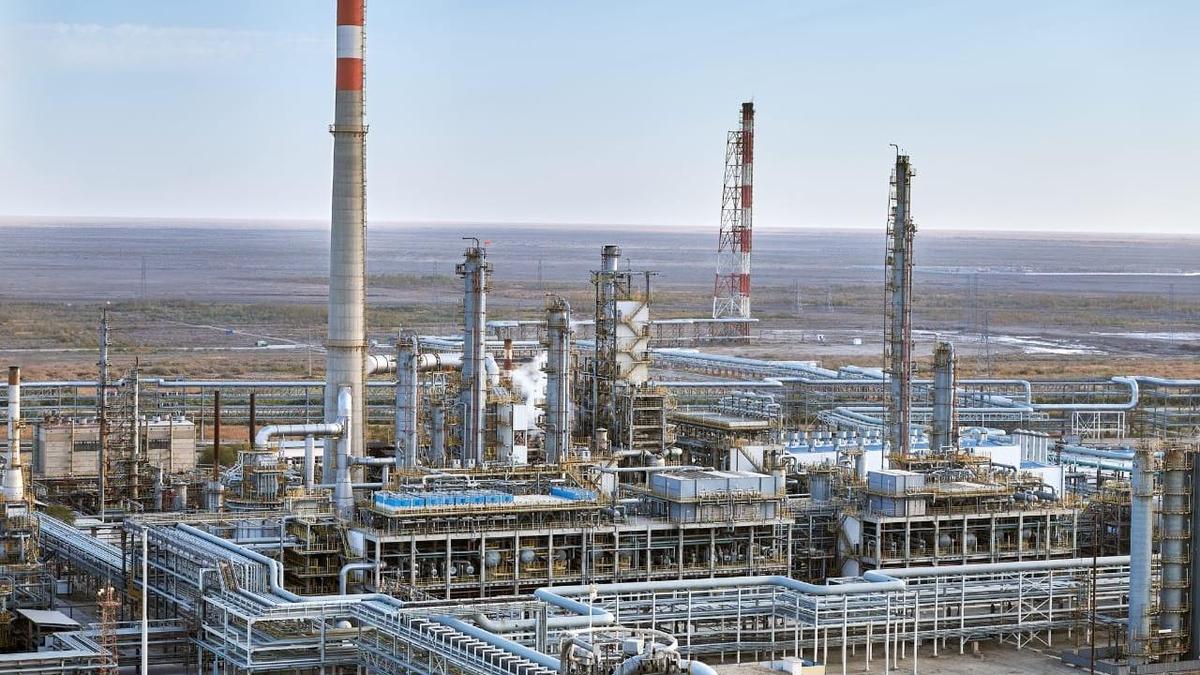
An unscheduled inspection of the Atyrau oil refinery, conducted by environmental officials following local residents' complaints about air quality, uncovered a range of violations of environmental requirements. This was reported by infohub.kz.
According to the Ministry of Ecology's website, specialists from the Atyrau Region Ecology Department found that the plant had not carried out emission calculations or established permissible emission standards for certain process furnaces at the ELU-AVT-2 and ELU-AVT-3 units, as well as for tanks at the delayed coking unit.
"It was established that on August 25 and between September 2 and 7, 2026, emergency situations at the CSU (combined sulfur production unit) and the CCU (catalytic cracking unit) led to emergency gas releases to the flare system. The total mass of gas burned during these periods exceeded 100 tonnes. Unplanned shutdowns and repair work were also recorded," the ministry said.
In addition, instrumental monitoring of industrial emissions recorded exceedances of established emission standards for carbon monoxide, nitric oxide and nitrogen dioxide at certain sources of the following production facilities: the CCR catalytic reforming unit (with continuous catalyst regeneration) with a benzene extraction section, part of the AHP (aromatic hydrocarbon production); the TEG (thermal and electrical energy production); and the light gasoline isomerization unit KUGDB-2 (combined unit No. 2 for hydrotreating gasoline and diesel fuel), title 3211.
"The inspection also revealed violations of requirements for the operation of the automated emission monitoring system and the implementation of measures to reduce emissions from stationary sources during periods of unfavorable meteorological conditions," the agency added.
Under Article 759 of the Administrative Offenses Code of the Republic of Kazakhstan, decisions to initiate administrative offense proceedings against investors included in the investor register must be coordinated with the prosecutor.
"On October 1, 2026, decisions to initiate administrative offense proceedings were coordinated with the prosecutor. The case materials have been sent to court for consideration and decision," the Ministry of Ecology noted.
Additional inspection materials were also sent to law enforcement agencies to determine whether there are signs of a criminal offense and to take appropriate procedural action.