

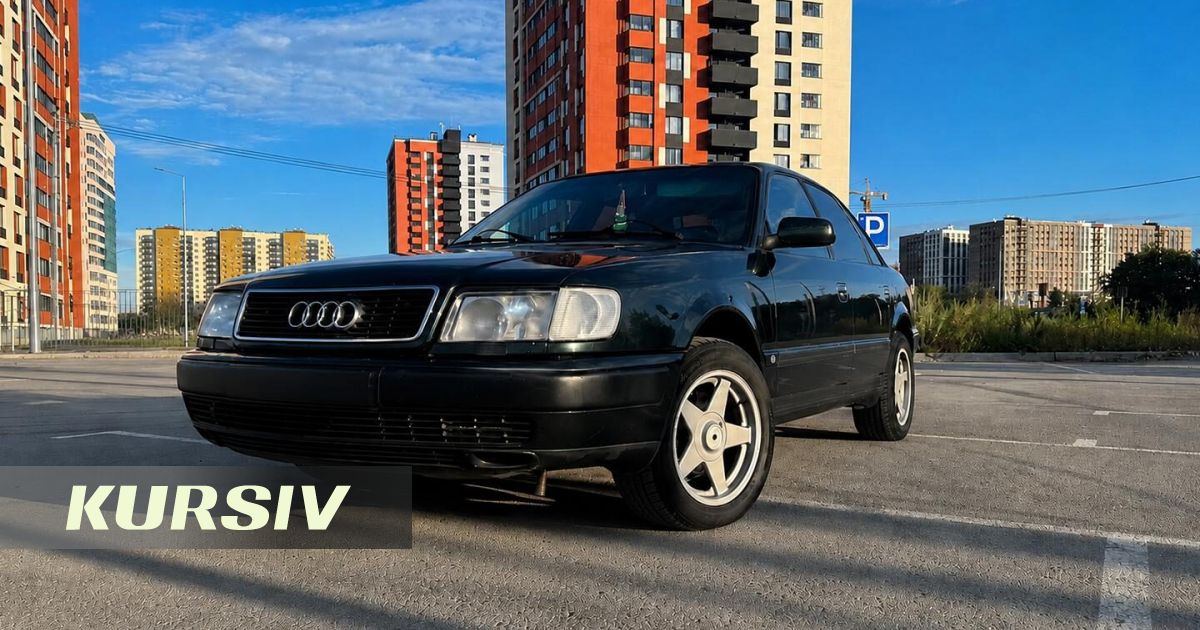
The legendary 1994 Audi 100 has covered nearly half a million kilometers and continues to impress with its reliability, fuel efficiency, and rust-resistant body. The owner shares the nuances of owning this car, reports infohub.kz.
The Audi 100 was the predecessor to the A6 family and earned nicknames like 'cigar' and 'herring' in post-Soviet countries. A prime example of the model's durability is a Russian example with nearly 500,000 km on the odometer, still used daily.
The main advantage of the old Audi is its body. The sedan retains almost all of its factory paint; only the hood has been repainted due to numerous stone chips. The owner attributes the lack of serious corrosion to the fully galvanized body. In his words, thirty-year-old Audis significantly outperform many BMWs and Mercedes-Benzes of the same age in terms of metal preservation. For Kazakhstan, where cars face not only temperature swings but also winter road chemicals, such resilience is especially relevant.
Under the hood sits a rare 2.5-liter diesel producing 115 hp, paired with an automatic transmission. Over the entire mileage, the cylinder head has undergone major repairs only once, at around 430,000 km. The owner says the engine is now in excellent condition. The diesel is also quite economical: fuel consumption in the city is up to 8 L/100 km, and on the highway about 6 L/100 km. For a large sedan from the early 1990s, these figures are quite modest.
Despite the sedan's age, common parts are not an issue: suspension components, timing belts, CV boots, and other consumables are readily available. A timing belt kit for the Audi can cost less than 10,000 rubles (about 53,000 tenge), which is cheaper than a kit for a Lada Kalina. However, rare parts are noticeably more expensive. For example, a one-piece rear taillight can cost at least 20,000 rubles (about 106,000 tenge). Finding an original is difficult, and aftermarket options may have poor fit and alignment.
The Audi 100 offered front or all-wheel drive, an aerodynamic body, and a wide range of engines, including the famous five-cylinder units. It was also cheaper than the BMW 5 Series and Mercedes-Benz E-Class. Today, the 'hundredth' is valued for its simplicity, repairability, and character. The owner, who has also driven more modern Audis, is in no hurry to replace it. In his opinion, new cars have become more technological and comfortable but have lost their individuality. On Kazakhstan's secondary market, the Audi 100 is still common. On Kolesa.kz, about 1,500 fourth-generation cars are listed for sale.