

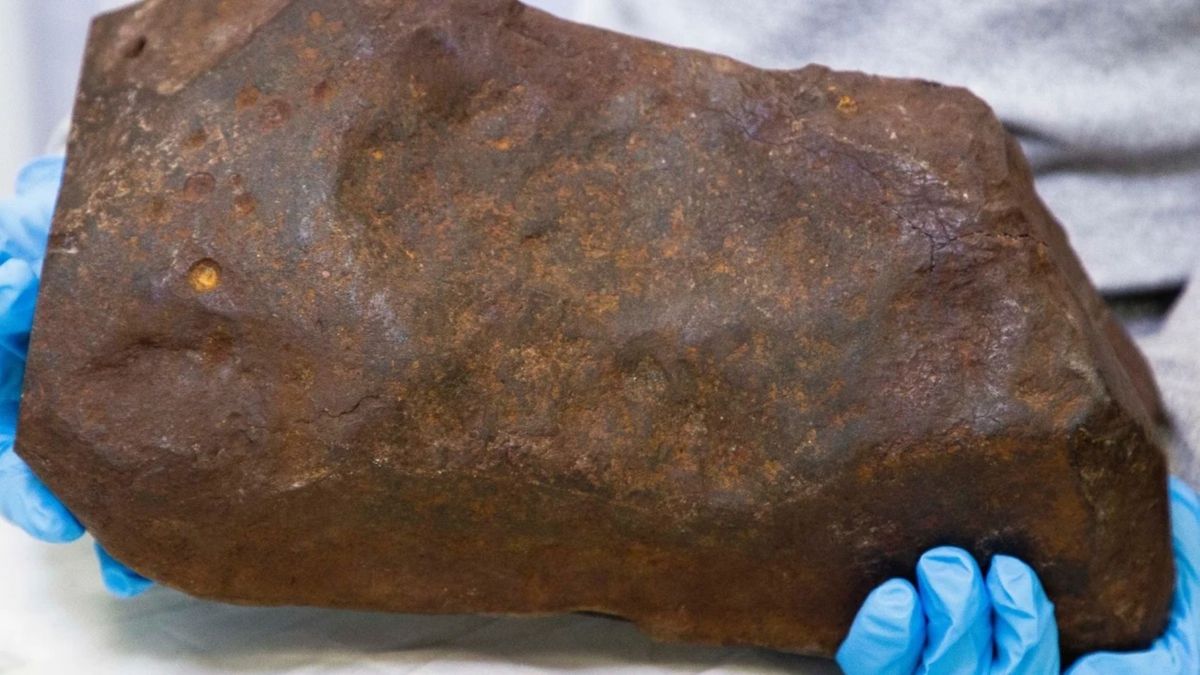
An Australian man spent years trying in vain to crack open a rock he found in the state of Victoria, hoping to find gold inside, but the discovery turned out to be far more valuable: a rare 4.6-billion-year-old meteorite, infohub.kz reports.
In 2015, David Hole was prospecting for gold with a metal detector in Maryborough Regional Park in central Victoria when he found an unusually heavy reddish rock in yellow clay. He was convinced it contained a gold nugget—after all, the park is located in a 19th-century gold rush area. He took the rock home and tried for years to break it open.
Hole used a rock saw, an angle grinder, a drill, poured acid on the rock, and hit it with a sledgehammer, but couldn't even make a crack.
Eventually, he took the indestructible specimen to the Melbourne Museum. Museum geologist Dermot Henry and honorary curator Bill Birch determined that it was not an Earth rock but a rare 17-kilogram meteorite, named Maryborough after the nearby town. According to Henry, in his 37-year career he has examined thousands of rocks that people believed were space objects, and only two of them turned out to be meteorites.
After cutting off a small fragment with a diamond saw, the scientists determined that the 4.6-billion-year-old meteorite is an ordinary H5 chondrite with a high iron content and tiny crystallized droplets of silicate minerals—chondrules. Experts estimate that it came from the asteroid belt between Mars and Jupiter and fell to Earth less than a thousand years ago.
For science, the find proved far more valuable than gold: it is only the 17th meteorite registered in Victoria and the second-largest chondrite in the region after a 55-kilogram specimen found in 2003.