

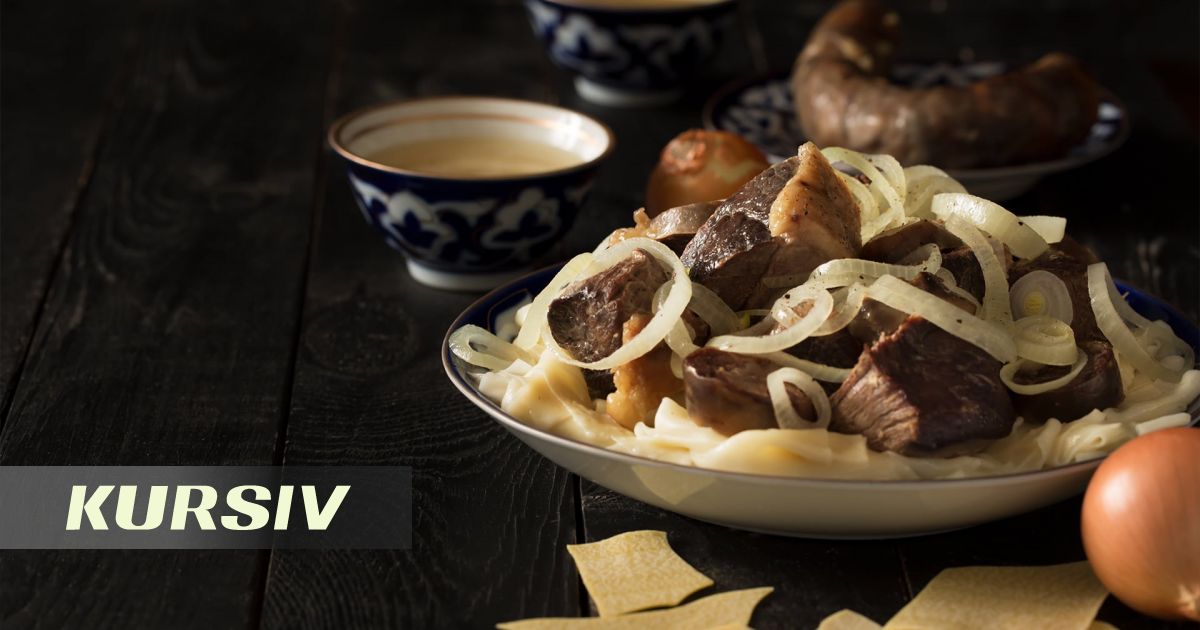
Traditional dishes may be gradually disappearing from the diets of young Kazakhstanis, participants at the Industry Day gastronomy forum in Almaty said, discussing why it is becoming harder for children to recognize the taste of besbarmak, kurt and other national foods, according to infohub.kz.
Artem Kantsev, brand chef at Qazaq Gourmet restaurant, shared a personal story that he said made him think about the future of traditional cuisine. When his son turned 10, Kantsev asked what he wanted on the holiday table. The child chose besbarmak, explaining that he was already tired of pizza and nuggets at other children's parties.
About 20 children attended the celebration. However, according to the speaker, 11 of them did not know what besbarmak was.
"This is a wake-up call, a very dangerous one," he said.
Kantsev stressed that this is not just a single gastronomic habit but a reason to think about how to preserve children's connection to traditional foods and flavors.
"Young people are eating kurt and other traditional products less and less often," he said, comparing attitudes toward national cuisine across generations.
In his view, preserving national gastronomy should be seen not only as a task for restaurants but also as a subject for research.
"We need to bring in science. There are probably some studies, or we need to conduct research in this area — how to preserve for our generation that native taste that is nurtured by our land," he said.
The discussion also touched on the idea that restaurants can play a special role in this process. In Kazakhstan, families with children actively dine out, so restaurants become one of the places where a child can first encounter traditional dishes.
This does not necessarily mean returning dishes to their original form. The restaurant business is already looking for ways to combine ingredients familiar to modern guests with elements of nostalgia.
One such example cited at the forum was the Almaty cafe Akku. Its brand chef, Yegor Yevstratov, said the team tries to work carefully with the establishment's image and guests' memories.
Thus, Akku has preserved coffee in a turka, kvass in a faceted glass, and dishes meant to evoke nostalgia in the older generation. Among them are cod liver and a sandwich with dill butter.
This represents a different approach to preserving gastronomic culture: not forcing the new generation to eat the same things their parents and grandmothers ate, but finding a modern form for familiar flavors.
If for some children besbarmak remains a dish from the holiday table, for others their first encounter with it may happen at a restaurant. And how well establishments can present traditional products in a modern way may determine their place on the next generation's menu.
Earlier, Kursiv LifeStyle reported that in Kulsary, an unusual format of one of the most famous dishes of Kazakh cuisine was created — freeze-dried besbarmak. The finished product only needs to be poured with hot water, after which the dish can be served.