

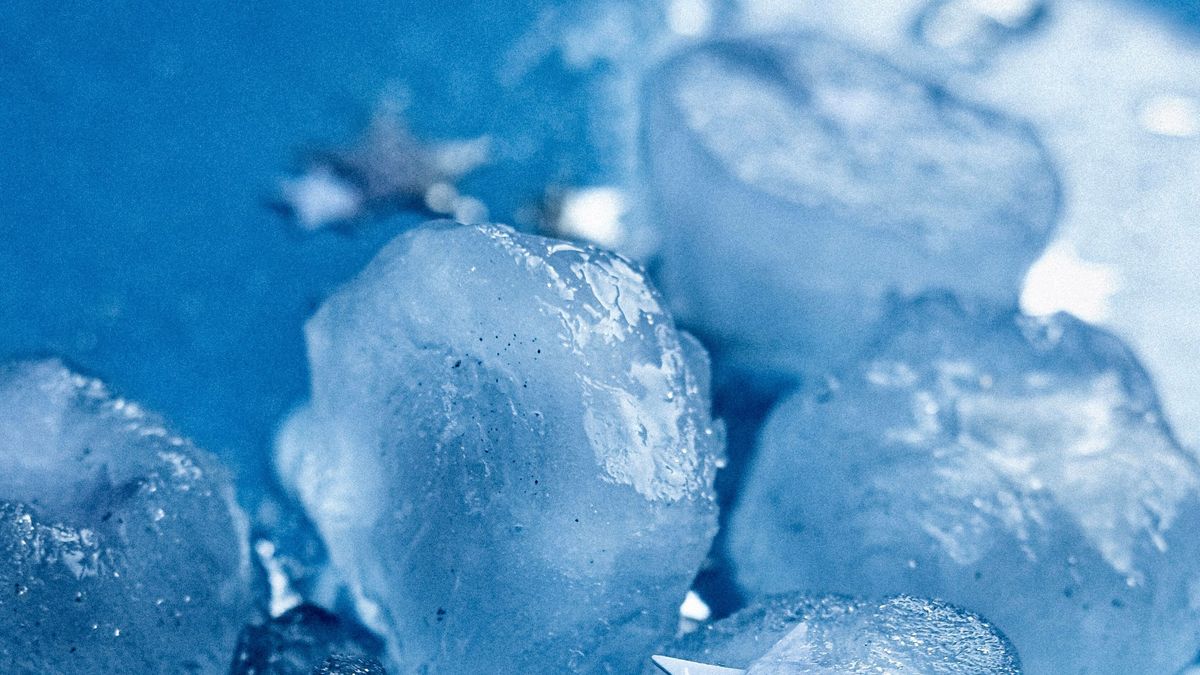
Israeli researchers have developed a biocomposite ice called BioPykrete that is 10 times stronger than ordinary ice and approaches concrete in its properties, the website infohub.kz reports.
The new material was created by specialists at the Hebrew University of Jerusalem. They managed to overcome the main problem with ordinary ice — its brittleness. The new composition can absorb roughly 70 times more energy before failure. Instead of instantly shattering into fragments when cracks appear, the material deforms and breaks more gradually.
The secret to its high strength lies in the incorporation of cellulose nanocrystals — tiny rigid particles derived from plant material. During freezing, these particles form a three-dimensional network within the structure. To reliably bind the cellulose to the ice, the researchers synthesized a special protein that acted as a bridging link. Using this molecular compound made it possible to double the strength and energy-absorption figures compared with conventional cellulose-and-ice mixtures.
The idea builds on military experiments from the Second World War, when scientists created pykrete from a mixture of ice and wood pulp. In the modern version, however, the authors used nanotechnology and protein bonds. According to the developers, the super-ice could be useful for construction in the Arctic and Antarctic, where delivering concrete and steel is too expensive. Nevertheless, the material remains a laboratory sample for now — scientists still need to test how it withstands repeated freeze-thaw cycles.