

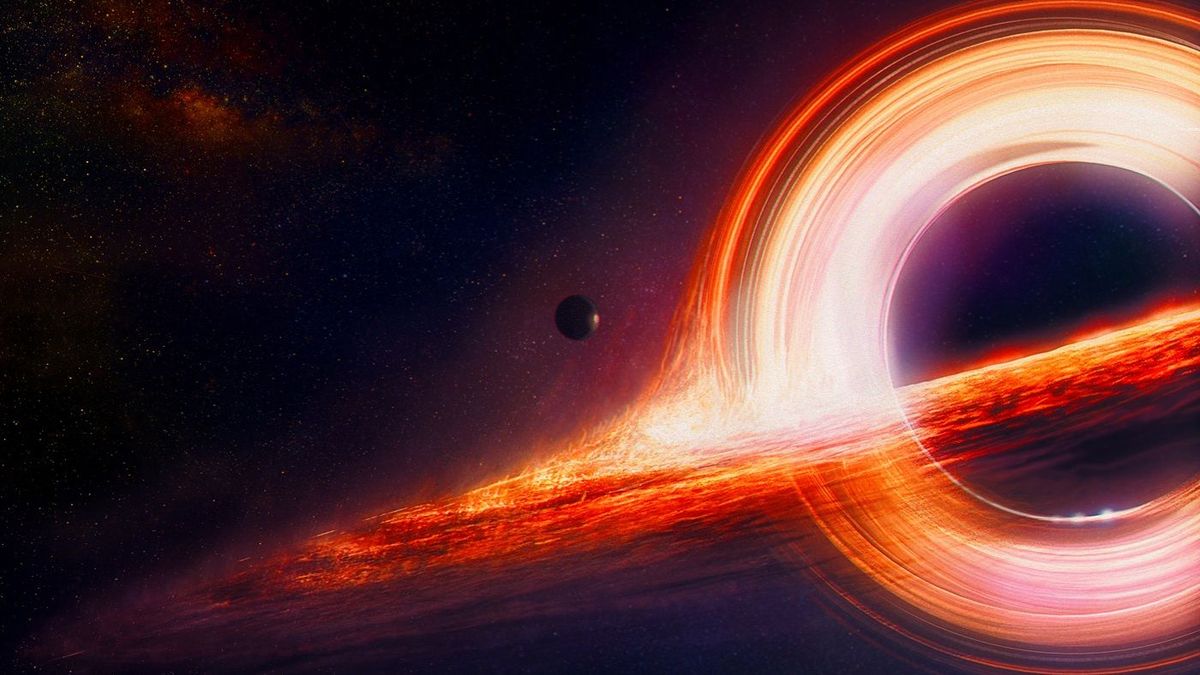
An international team of theoretical physicists has identified a mathematical loophole in the laws of physics that would allow a single black hole to decay into two independent gravitational objects under extreme conditions, the website infohub.kz reports.
The study by researchers from the University of Southern Denmark, the University of Naples Federico II and the French National Centre for Scientific Research (CNRS) was published in the journal Physical Review D. The authors examined the constraints imposed by general relativity and thermodynamics to determine whether a process strictly reverse to the familiar gravitational merger of cosmic giants is possible.
The main obstacle to black hole decay is the second law of thermodynamics: for stationary, non-rotating objects, splitting would reduce the total entropy of the system, making decay energetically impossible. However, calculations by the team of Francesco Sannino and Giacomo Cacciapaglia showed that the situation changes at extremely high rotation rates. When a black hole's spin approaches the maximum physically permitted limit, the entropy barrier is overcome and the event horizon acquires the topological possibility of splitting into two branches.
A second decay mechanism is linked to theories that posit the existence of extra spatial dimensions. In such models, the stability of the event horizon is disrupted, making the decay process energetically favorable, especially when one of the resulting objects is significantly smaller than the other. The researchers note that detecting the phenomenon with telescopes would be difficult, but the Fermi-LAT orbital gamma-ray telescope could in theory pick up gamma-ray bursts from the decay of primordial relic black holes.