

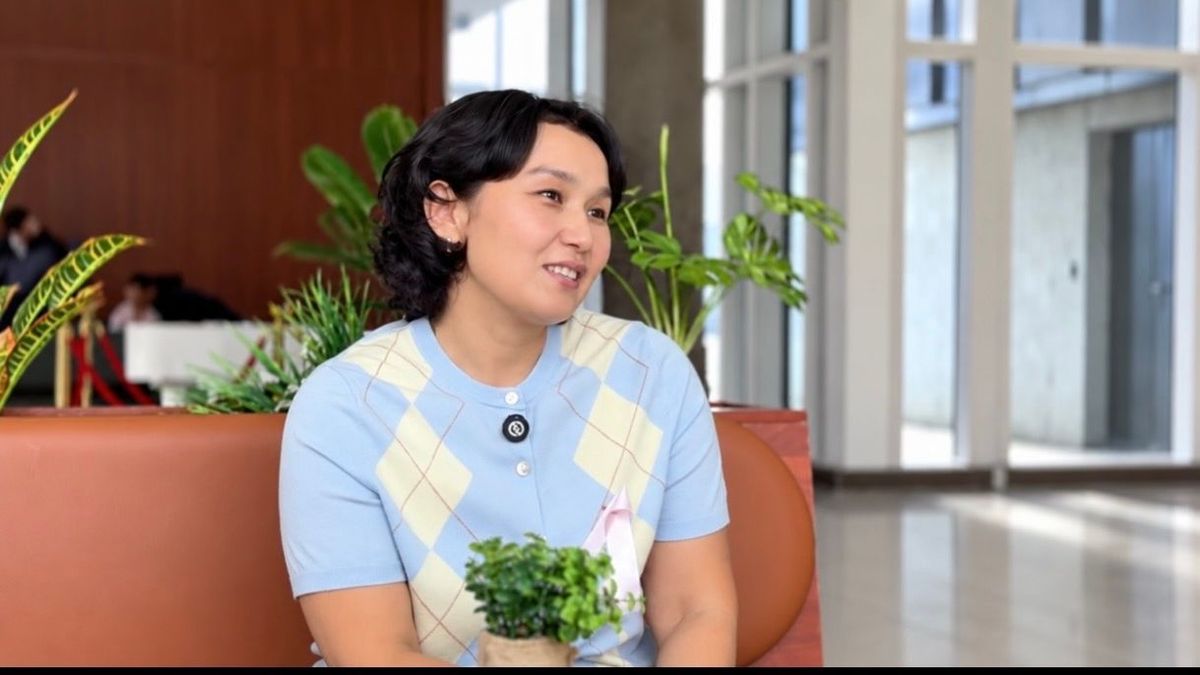
After discovering a lump in her breast, Ilmira Alenova did not put off seeing a doctor and sought medical help the very next day. An ultrasound and a biopsy confirmed the diagnosis. The National Scientific Oncology Center shared the details of her story, infohub.kz reports.
Taking into account the results of genetic testing and her individual cancer risks, the team at the National Scientific Oncology Center (NSOC) chose a comprehensive surgical approach for Ilmira. In a single operation, the doctors removed the breast affected by the tumor and performed reconstruction, and also carried out preventive procedures aimed at reducing the risks associated with the identified mutation.
"During my treatment at the NSOC, I was looked after by Anna Malysheva, Asel Sadvakasova, Alexander Digay, Aida Shakirova and Raushan Kaimbekova. That is how many specialists were involved in treating a single patient! Of course, the support of my loved ones played a big role, as did the doctors who said: 'Everything is fine, everything is curable if it is detected in time and the treatment is completed,'" Ilmira Alenova shared.
The treatment approach for breast cancer (BC) depends on many factors. It is important not only to confirm the diagnosis but also to determine the biological characteristics of the tumor. The choice of the most suitable therapy depends on the results of these tests.
"Once the disease is suspected and detected, an important stage of diagnosis begins – establishing the diagnosis on the basis of a histological examination. BC is a large group of tumors. Even in two women with the disease at the same stage, the tumors may differ in their biological properties, prognosis and response to therapy," said Maria Urezkova, a pathomorphologist at the NSOC.
To determine the characteristics of the tumor more precisely and select the appropriate treatment, specialists carry out an immunohistochemical study. It complements the histological analysis and helps doctors choose the further approach taking into account the specifics of the disease.
Surgery is also selected individually. Depending on the clinical situation, the patient may be offered breast-conserving surgery or a mastectomy with immediate reconstruction. In the first half of 2026, about 150 patients received treatment at the center.
"Our center provides the full range of medical services for the diagnosis and treatment of BC. Once the surgical approach is determined, we decide individually which scope of surgery suits a particular patient. We perform breast-conserving surgery, subcutaneous mastectomy, including with immediate implant reconstruction, and we also remove benign formations," said Asel Sadvakasova, an oncologist-mammologist at the NSOC.
The international Pink October initiative, dedicated to raising awareness of BC, reminds people of the importance of early detection. As part of it, the NSOC held an Open Day where women could receive a free consultation with an oncologist-mammologist and get information about diagnosing the disease.
According to the World Health Organization, about 2.4 million new cases of BC were detected worldwide in 2024. Almost 700,000 women died from the disease. It remains the most common type of cancer among women.
Ilmira's story shows how important it is not to put off seeing a doctor when lumps or other changes in the breast are found. Self-examination helps to notice changes, but it does not replace a professional examination and the recommended screening.
Pink October is ending, but care for one's health continues all year round.