

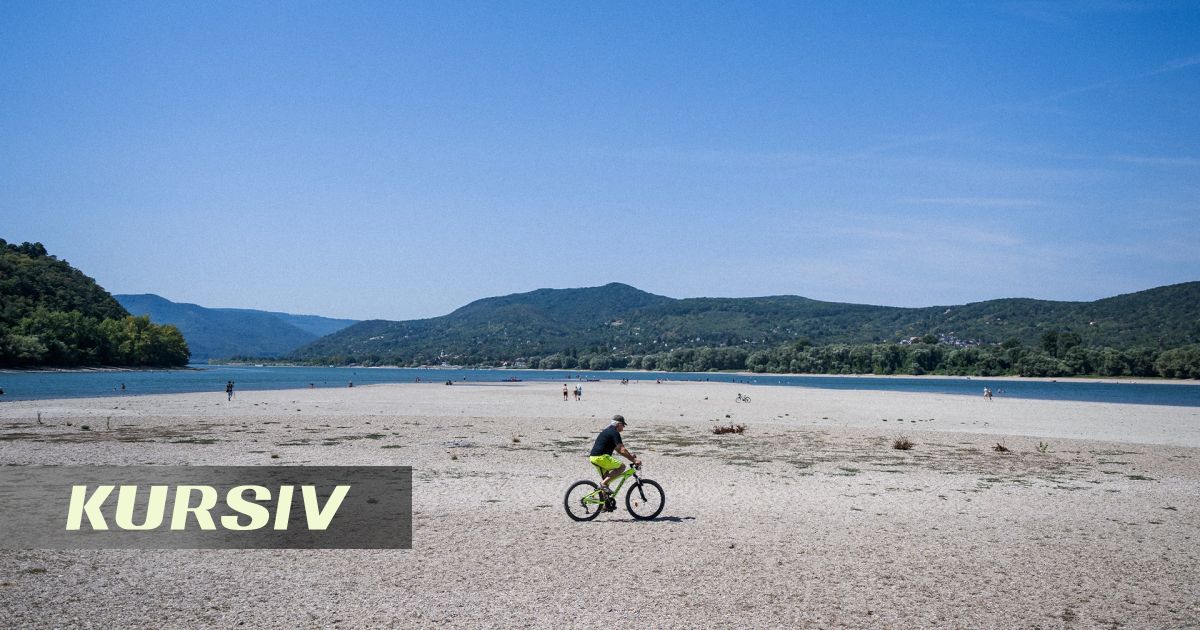
Anomalous heat and drought in Hungary have caused the Danube to drop to a record low: the water level in Budapest fell to 23 centimeters, 10 centimeters below the previous record low set in 2018. The river has become so shallow that in some stretches of the riverbed, people can ride bicycles, and historical artifacts are being discovered on the exposed sandbars, reports infohub.kz.
Gábor Dezső Kürthy, head of the Hungarian Cycling Club, cycled more than 30 kilometers from Budapest to the town of Vác along sections that are usually underwater. This has become one of the most unusual consequences of the low water levels.
Near the town of Visegrád, an almost perfectly round stone ball was found on a dried-up sandbar. Archaeologists suggest it could be a projectile for a medieval catapult used during sieges of Visegrád Castle. If confirmed, the artifact could be anywhere from several hundred to nearly two thousand years old.
Earlier, a sunken World War II ship was also discovered in the dried-up riverbed of the Danube.
Satellite images from the European Copernicus program show how much the river has changed over the past year: compared to July 2025, extensive sandbars have appeared in the bends, hindering navigation. In some sections, cargo and passenger ships can no longer pass, and restrictions have been imposed on river transport in Budapest.
Hungarian authorities have declared a state of emergency due to the drought. According to the country's Ministry of Environment, serious water shortages are observed in about three-quarters of the regions. Forecasters do not expect rain in the next two weeks, and temperatures could rise to nearly 39 degrees Celsius.
Earlier it was reported that Hungary, for the first time in 44 years, would temporarily halt operations at its only nuclear power plant, Paks, due to the record drop in the Danube's water level, which the plant uses for cooling its reactors.