

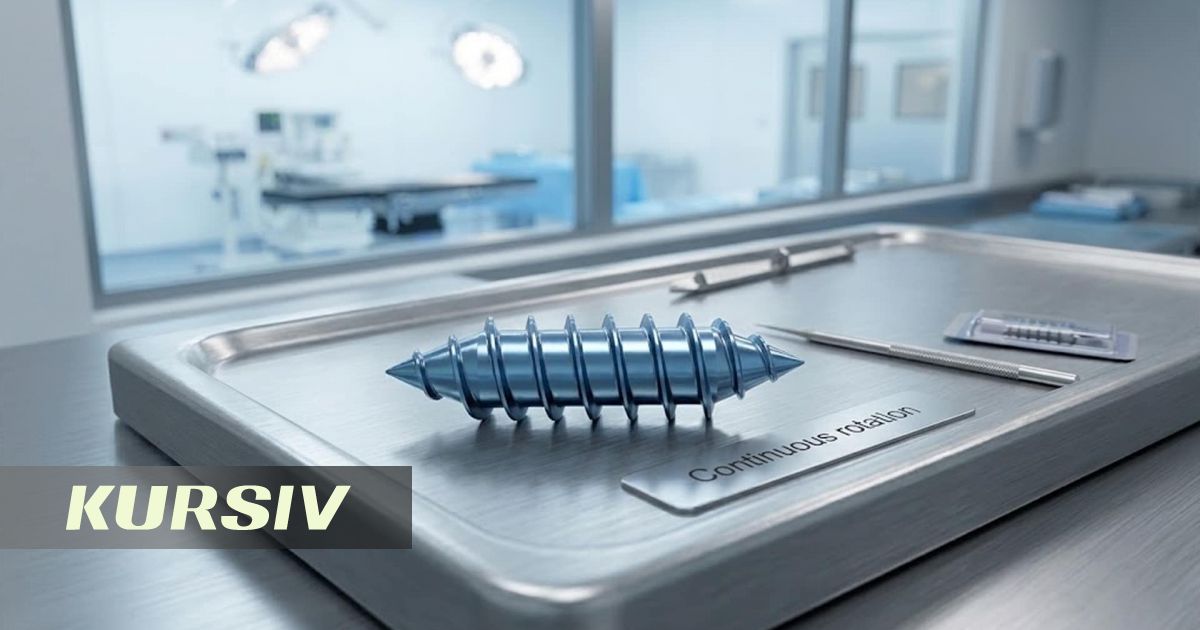
Researchers in the Netherlands have developed a miniature screw-shaped robot capable of navigating through brain tissue on its own. This technology could revolutionize drug delivery to deep brain regions, according to infohub.kz.
Specialists from the University of Twente and Radboud University Medical Center have created a device controlled by an external magnet. The rotation of the magnetic field propels the robot forward, literally "drilling" through surrounding tissue. This approach allows access to deep-seated brain areas without the need to open the patient's skull.
A key feature of the technology is its ability to reach the target site through the bloodstream and tissues, significantly simplifying complex medical procedures. As the robot moves, it rotates in sync with the external magnet; however, if the rotation speed becomes too high, it loses control and moves erratically. This limit depends on tissue stiffness: in soft media, the robot could achieve speeds up to 30 revolutions per second, while in stiffer tissue it dropped below one revolution.
During experiments, the robot was tested on a soft gel model of the brain and on real sheep brain tissue. Without blood flow, it maintained synchronization with the magnet up to about 1.8 revolutions per second, while simulating circulation lowered the safe threshold to 0.45 revolutions per second. Through brain tissue, the robot moved at about 0.2 mm per second, and when moving backward, up to 2.9 mm per second, since it did not have to carve a new channel.
The accuracy of reaching a target point was less than one millimeter, which, according to the researchers, opens up possibilities for more precise targeting of tumors in deep brain regions. So far, the technology has only been tested in laboratory settings, but if it proves effective in further studies, it could be used for complex brain procedures without the need to open the skull.
Earlier, it was reported that scientists at the University of Gothenburg in Sweden presented an unusual soft robot that moves like a real caterpillar. In the future, such a device could be used for inspecting sewer pipes and even for exploring Mars.