

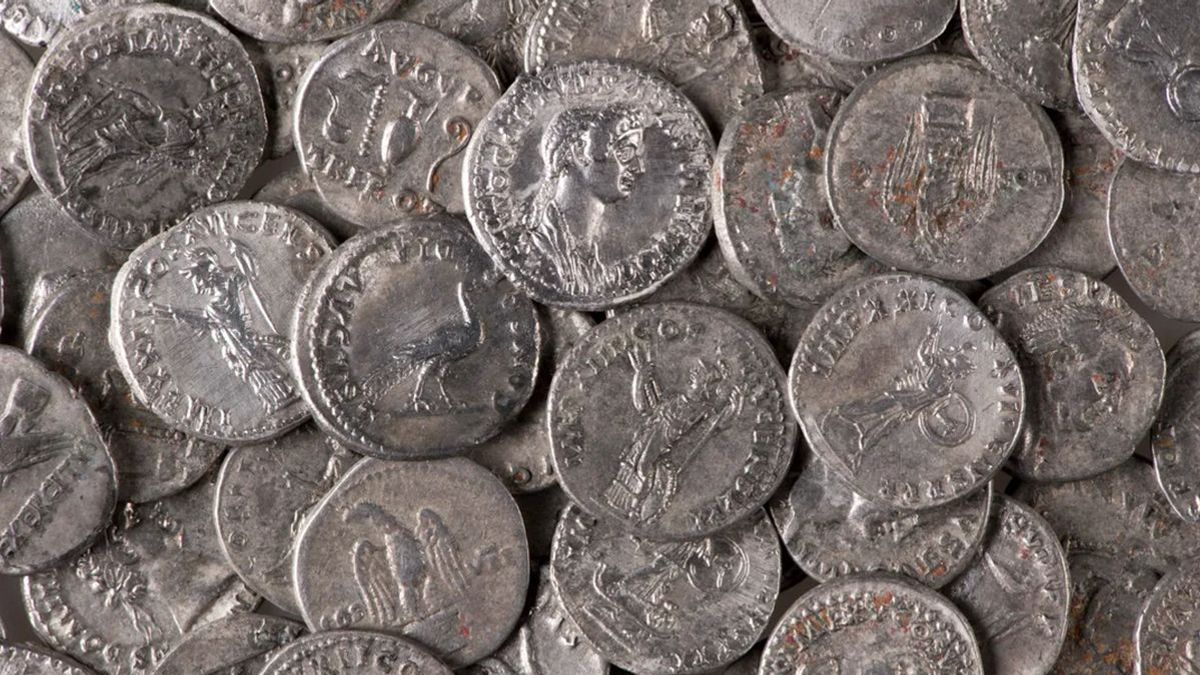
An amateur archaeologist with a metal detector has discovered a large hoard of 934 Roman silver coins in Germany, according to infohub.kz.
A hoard from the era of Emperor Hadrian, spanning nearly 300 years of Roman Empire history, has been found in the state of North Rhine-Westphalia, reports Smithsonian magazine. One of the largest hoards of Roman silver coins was discovered in Germany near the town of Wesseling, south of Cologne. The find was made by amateur archaeologist Oliver Riedl, who was searching a field with a metal detector under an official permit from the authorities of North Rhine-Westphalia.
After discovering the first 15 coins, Riedl notified the Regional Association of Westphalia-Lippe (LVR) for the Preservation of Archaeological Monuments. Specialists who arrived extracted a block of soil with its contents and sent it to the restoration workshop of the LVR-LandesMuseum in Bonn. X-rays and subsequent excavations revealed that the hoard, weighing about three kilograms, consists of 934 silver denarii. Along with them, experts found fragments of a ceramic vessel and traces of straw, in which the money was originally stored before the pot was damaged by agricultural work.
The youngest coin in the collection dates to 124–125 AD, corresponding to the reign of Emperor Hadrian, while the oldest dates to 148 BC from the Roman Republic era. The total sum of the find is equivalent to approximately six years' accumulated pay of an ordinary Roman legionary of that time. As noted by Erich Claßen, director of the LVR office, the owner likely buried the savings for safety and died before he could retrieve the hoard. The find is currently on display at the museum in Bonn.