

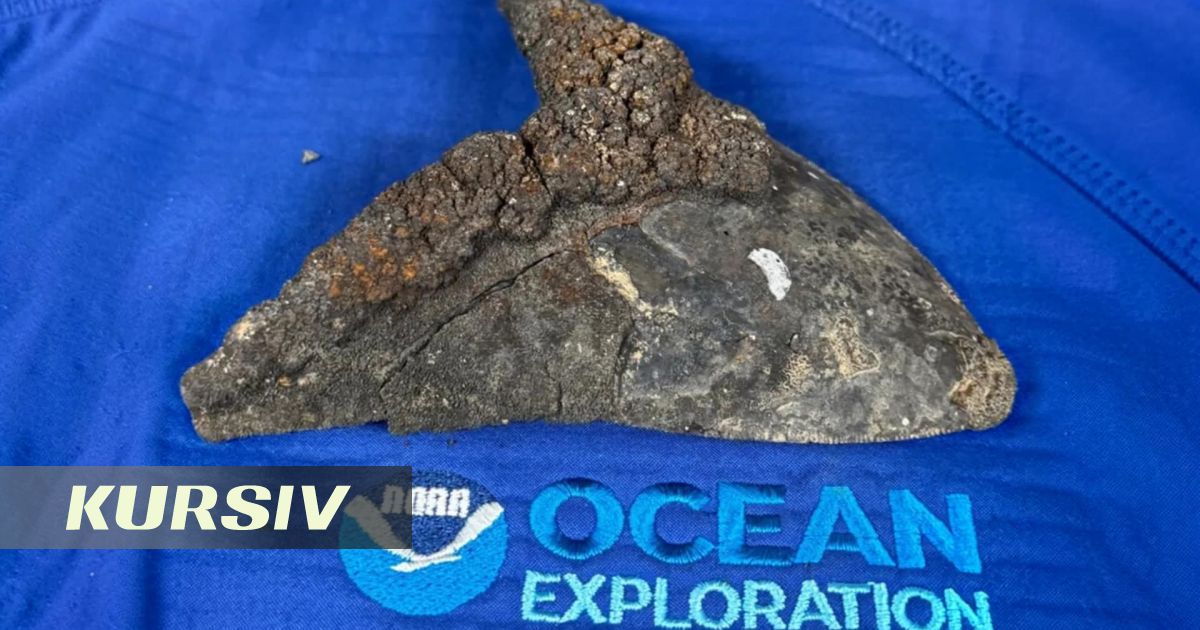
During a deep-sea expedition in the Pacific Ocean, researchers stumbled upon several teeth of the megalodon — a giant shark that went extinct over three million years ago. This unusual find could provide scientists with much more information than it seems at first glance, reports infohub.kz.
The expedition is being conducted by the U.S. National Oceanic and Atmospheric Administration (NOAA) in the vicinity of the Cook Islands. The primary goal of the mission is to study the seafloor and deposits of polymetallic nodules rich in rare earth metals.
However, among these formations, researchers also discovered a far more unexpected find — several large megalodon teeth. According to scientists, each of them exceeds seven centimeters in length.
Because shark skeletons are mostly made of cartilage, their remains rarely fossilize. But teeth fossilize well and can lie on the seafloor for millions of years.
Over time, they gradually become coated with layers of iron, manganese, and rare earth elements. This is why such finds are of particular interest to science.
Researchers explain that the chemical composition of such fossils helps reconstruct the picture of ancient ocean currents and understand how Earth's climate changed in the distant past. For example, the neodymium content in the teeth allows tracking how ocean waters circulated millions of years ago.
The NOAA expedition is ongoing, and scientists hope to find new specimens that will help better understand the history of ancient seas and their most formidable predators.
Earlier, Kursiv LifeStyle reported that an 11-year-old schoolboy from the UK went for a walk on the beach and returned with a find nearly 1.8 million years old. The boy accidentally discovered a tooth of an ancient relative of the modern elephant.