

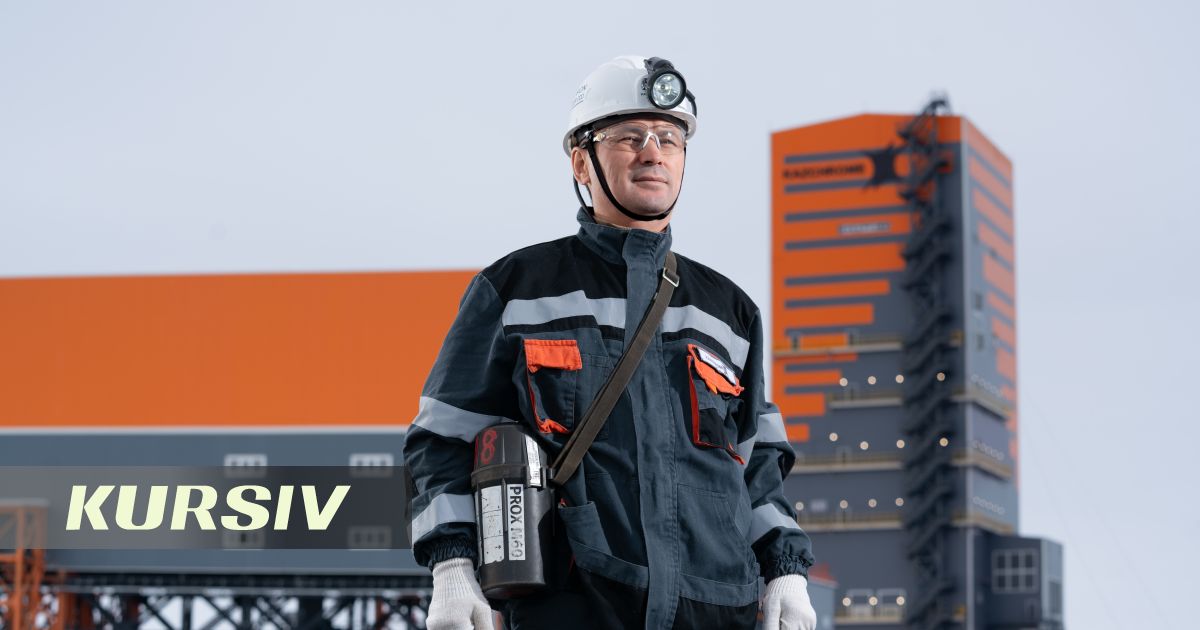
The Bolashak mine at the Donskoy Mining and Processing Plant, one of ERG's largest investment projects, faced an unexpected challenge: the release of natural hydrogen in its underground workings. This led to a temporary suspension of operations for research. Today, the mine is operational again, but the path to resumption required a rethink of safety approaches, reports infohub.kz.
The mine's design capacity is up to 7.5 million tons of chrome ore per year, ensuring a long-term raw material base and the development of Kazakhstan's ferroalloy production. However, shortly after launch, the Kazchrome team detected natural hydrogen emissions. The main task was to identify the sources and volumes of gas release and to develop control measures.
Research showed that the hydrogen was formed in the rock mass as a result of natural chemical processes that occurred millions of years ago. Under certain conditions, the gas is released and enters the workings. To study this process, scientific institutes from Kazakhstan, Russia, Turkey, and Germany were involved. Specialists developed additional technical and organizational safety measures.
In parallel, the mine was prepared for resumption: workings were re-bolted, transport horizons were restored, the number of development crews was increased, and aerogas control was strengthened. Mine manager Nurlan Abdullin noted that hydrogen is lighter than air, so it rises and can accumulate in the dome part of the stope. This property formed the basis for a degassing project using descending boreholes.
Today, hydrogen is removed in two ways: through inclined boreholes from the overlying horizon and through the mine ventilation system. Internal boreholes are drilled in advance, and a degassing pump station is used to force gas removal through a vertical borehole from the surface. It is important to control gas movement, so ventilation is organized to prevent accumulations in working areas.
To model airflows, the VentSim program is used, allowing solutions to be tested on a computer before implementation. Automatic ventilation doors are also being installed for precise flow control. The mine is equipped with a personnel positioning and emergency alert system; each miner has a lamp with an information panel.
Control of the mine atmosphere has been strengthened: all miners received modern gas analyzers, and sensors built into headlamps transmit data to the dispatcher in real time. An aerogas control system based on stationary gas analyzers has been introduced. Algorithms for actions in case of exceeding permissible hydrogen concentration have been developed.
Shakhmarat Mutalip, member of the ERG S.à r.l. Management Board, emphasized that human life and health are a priority, and production development must be accompanied by increased safety. Hydrogen control work is proceeding in parallel with the transition to the modern underground mining technology Sublevel Caving (SLC), which involves a high level of mechanization and automation.
Baurzhan Utemisov, director of the Donskoy Mining and Processing Plant, noted that safety is ensured by a set of measures: people, science, engineering solutions, digital technologies, and equipment. Kudret Shamiev, General Director of ERG in Kazakhstan, stressed the strategic importance of the mine for the country and the importance of implementing new technological solutions.
Bolashak in numbers: investments over 1 trillion tenge, capacity up to 7.5 million tons of ore per year, about 800 jobs.