

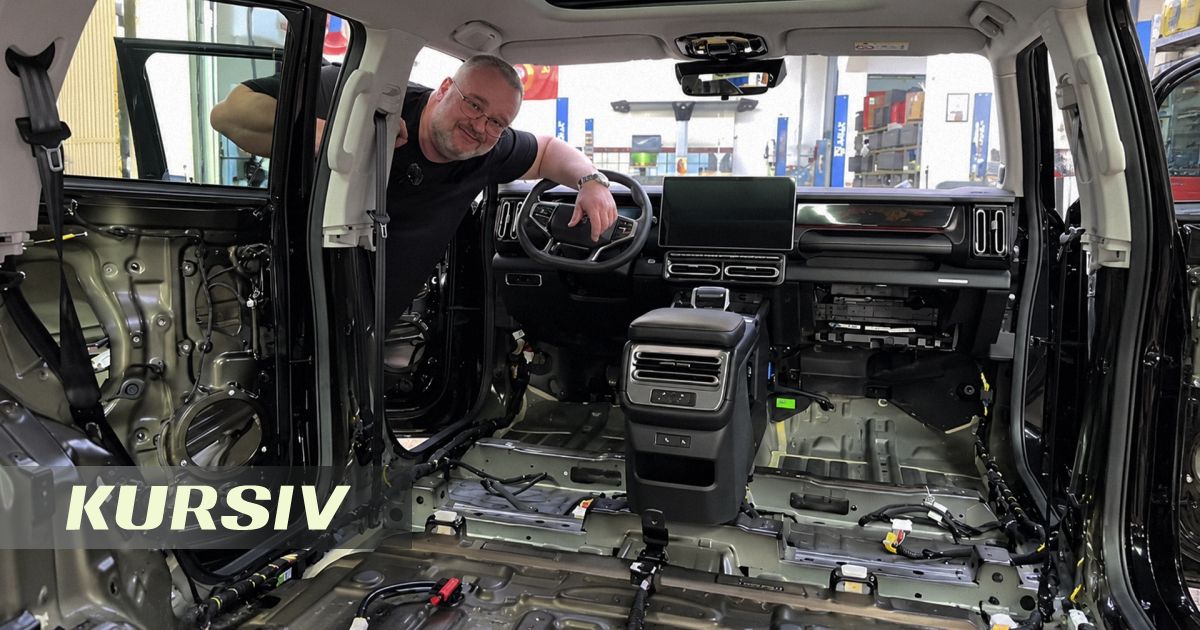
The popular Chinese crossover Jetour T1 was given a detailed teardown at "Club Service." The owner of the repair shop and auto blogger Ilya Sviridov demonstrated the construction of the doors, body and suspension, and also drew attention to unconventional engineering solutions, according to the website infohub.kz.
According to Sviridov, the Jetour is about seven months old, and in that time it has already changed owners. The new owner complained of a strange knocking sound and decided to have sound insulation installed. Inside the door, a loose bracket was found, which, in the author's view, could have been the source of the noise.
"Believe me, we didn't loosen anything. This is how it arrived from the factory," the reviewer said.
The first unexpected discovery was the thickness of the metal. Sviridov admitted that before getting acquainted with the T1 he had been skeptical of the brand, but has now revised his opinion.
"This metal is thicker than on today's Toyotas," he said.
At the same time, the design of the door reinforcements puzzled him: instead of a tubular element, profiles of complex shape are used.
"If you ask me, it wouldn't hurt to put a tube inside," the blogger noted, discussing protection in a side impact. He did not, however, cite any crash test or structural strength test results.
In the rear doors, foam, vibration insulation and reinforcements of unusual shape were found.
"Everything is here, like on the canvas of a good artist. Pure abstractionism and complete freedom for Chinese design ideas to take flight," Sviridov joked.
In the trunk, he showed vibration insulation, sealant and welded seams. The blogger criticized certain joints of the body panels, but overall rated the workmanship positively.
"For a mass-market Chinese car, it's really well put together," he concluded.
On the lift, Sviridov noted the ventilated front brake discs. At the rear, thick but non-ventilated discs are fitted. The rear multi-link suspension also raised questions. The blogger noted the shape of the arms, the mounts and the location of the silent blocks, comparing certain solutions with Volkswagen and Toyota designs, but did not draw conclusions about reliability.
"I've just been fixing cars for 20 years, and when I see something strange, I show it to you. After that, think for yourselves," he explained.
Under the floor pan, a driveshaft, an all-wheel-drive coupling, a rear differential and drive axles were found. At the front, there is a subframe, metal protection and arms with passenger-car-type silent blocks.
Despite its rugged looks and all-wheel drive, Sviridov considers the T1 primarily a crossover for ordinary driving rather than heavy off-roading. In his opinion, it is a typical mass-market vehicle whose job is to get its owner from point A to point B. At the same time, for its price the car gives its owner a modern interior, all-wheel drive, a two-liter turbo engine and a set of equipment that a buyer of such a crossover expects.
All of Club Service's remarks relate to a specific Jetour T1 built for the Russian market. Kazakh versions may differ in welding quality, sound insulation, materials and other details. Therefore, extending the teardown's conclusions to all T1s in Kazakhstan without inspecting a specific vehicle is incorrect.
Earlier, Kursiv Auto wrote about how a Jetour T2 with a classic automatic transmission was tested in the foothills of Almaty.