

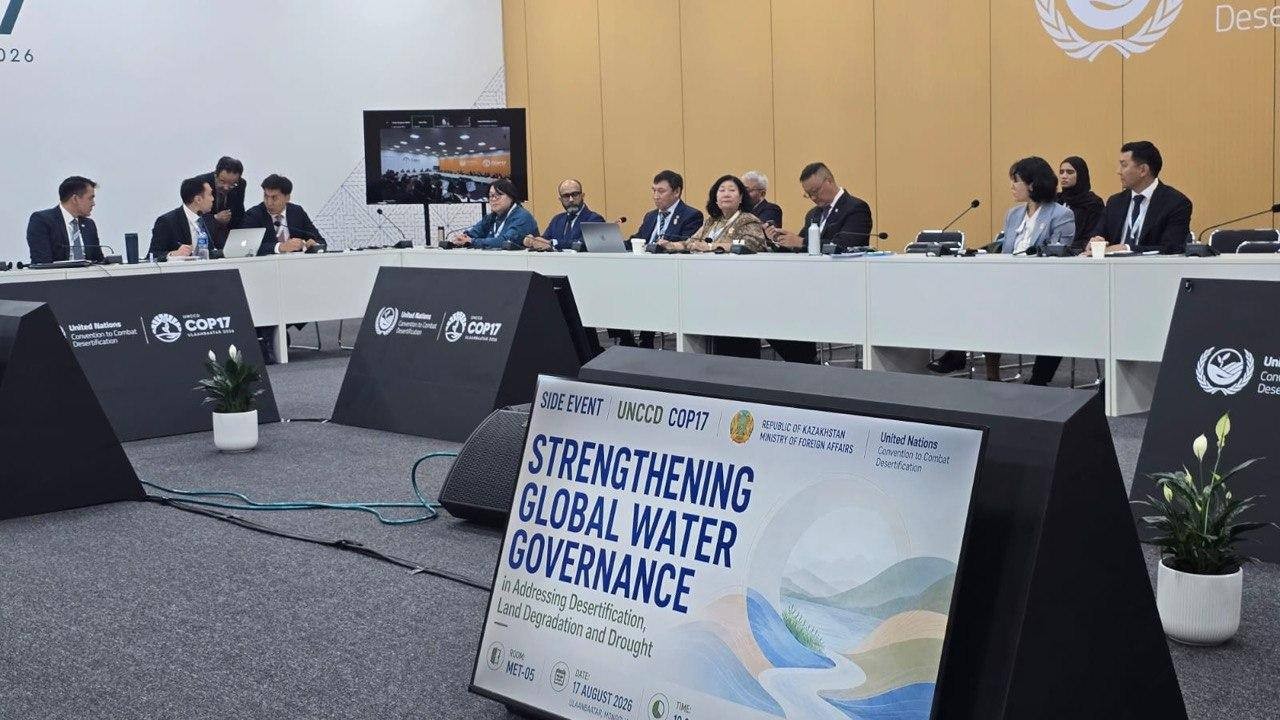
Water scarcity, climate change, and land degradation require not isolated measures but a unified approach to managing natural resources. At the 17th session of the Conference of the Parties to the UN Convention to Combat Desertification (UNCCD COP17), Kazakhstan presented its experience in this field and outlined new legislative and international initiatives, reports infohub.kz.
Marat Kazhenov, Deputy Chairman of the Land Management Committee at Kazakhstan's Ministry of Agriculture, took part in a side event held within the framework of COP17 in Ulaanbaatar.
The main topic of the international discussion was strengthening global water governance to address desertification, land degradation, and drought. Participants examined the interconnection between land and water resources and discussed the need for an integrated approach to their sustainable use, the Ministry of Agriculture of Kazakhstan reported.
Kazakhstan presented national experience in land and water management based on principles of sustainable natural resource use, scientifically grounded decisions, and international cooperation.
In his speech, Marat Kazhenov emphasized that the state of land and water resources is directly linked to food, environmental, and economic security.
"Amid growing water scarcity, climate change, and intensifying land degradation, issues of their rational use require coordinated decisions at both national and international levels," he stressed.
One of the topics of the speech was the head of state's initiative to establish an International Water Organization. Kazakhstan views it as a potential international platform for coordinating states' actions, exchanging best practices, and jointly developing solutions to global water-related challenges.
Special attention was paid to the law of the Republic of Kazakhstan "On Soil Protection," adopted in 2026. The document forms the legal basis for systematic preservation of soil cover, prevention of degradation processes, and improvement of state regulation in soil protection, the Ministry of Agriculture of Kazakhstan said.
The Kazakh side also noted the need to introduce modern soil-protection technologies. For sustainable land use, according to discussion participants, the development of scientific research, the use of digital monitoring tools, and the expansion of international knowledge and practical experience exchange are important.
At the same time, the protection of land resources is inextricably linked to ensuring water security.
"Land conservation cannot be considered in isolation from water security issues. Soil degradation, droughts, and water scarcity are interconnected challenges requiring comprehensive and coordinated solutions," noted Marat Kazhenov.
Kazakhstan's participation in the side event allowed presenting to the international community national approaches to land protection and legislative decisions adopted in this area.
In addition, representatives of participating countries discussed further cooperation in sustainable natural resource management. Practical measures to prevent land degradation and combat drought were in the spotlight.
Following the discussion, participants emphasized the need to combine scientific potential, state mechanisms, and international partnership. This approach is seen as one of the key conditions for effective land and water management amid climate change, growing water scarcity, and intensifying land degradation processes.