

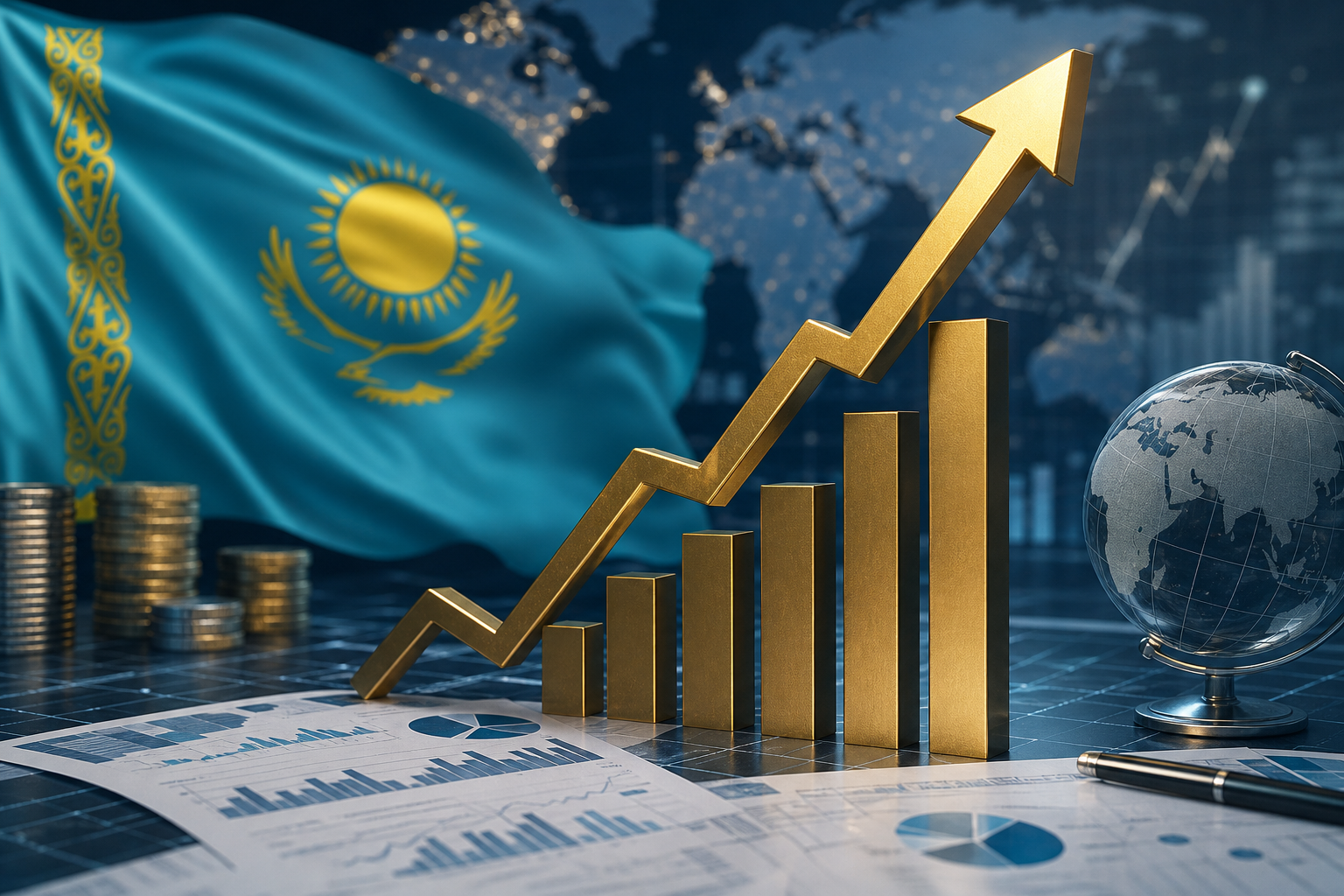
Despite dimming global economic expectations, the International Monetary Fund has maintained its forecast for Kazakhstan, rating its prospects significantly higher than most major economies, reports infohub.kz.
The IMF has revised its global economic outlook. According to the updated assessment, global real GDP will grow by 3% in 2026 and 3.4% in 2027, a downward revision from the April forecast. The IMF cited the lingering effects of the Middle East conflict as the main cause, though experts note that part of the negative impact is offset by advances in artificial intelligence and accelerating technological progress.
Against the backdrop of a global slowdown, Kazakhstan maintains strong growth. The IMF projects the country's real GDP will increase by 4.6% in 2026 and 4.4% in 2027. Among the economies in the IMF's survey, only India (6.4%), Indonesia (5%), and Malaysia (4.7%) are expected to grow faster next year. Kazakhstan's forecasts are comparable to those of Egypt and China, with its 2027 outlook surpassing China's.
For most other large economies, IMF estimates are much lower: the U.S. is expected to grow 2.3%, Brazil 2.4%, Turkey 2.9%, Poland 3.4%, Mexico 1.2%, Saudi Arabia 1.7%, and Russia 1.1%. Among developed nations, South Korea leads with 2.6%, followed by Spain at 2.1%, Australia 1.9%, Canada 1.1%, the U.K. 1%, Germany 0.7%, France and Japan 0.6% each, and Italy just 0.5%.
Overall, the IMF forecasts advanced economies will grow just 1.7% in 2026, and the eurozone 0.9%. Emerging market and developing economies are expected to average 3.8%, with developing Asia at 5%, Latin America and the Caribbean at 2.4%, and sub-Saharan Africa at 4.3%. However, the Middle East and Central Asia region is projected to grow only 0.7% due to ongoing geopolitical instability.
The July revision was unfavorable for many countries. The IMF downgraded forecasts for the eurozone, Germany, France, Japan, Canada, Turkey, Mexico, Saudi Arabia, and several other economies. Meanwhile, Kazakhstan's forecast remained unchanged from April, reflecting the fund's sustained high assessment of the country's economic resilience and growth potential amid global uncertainty.