

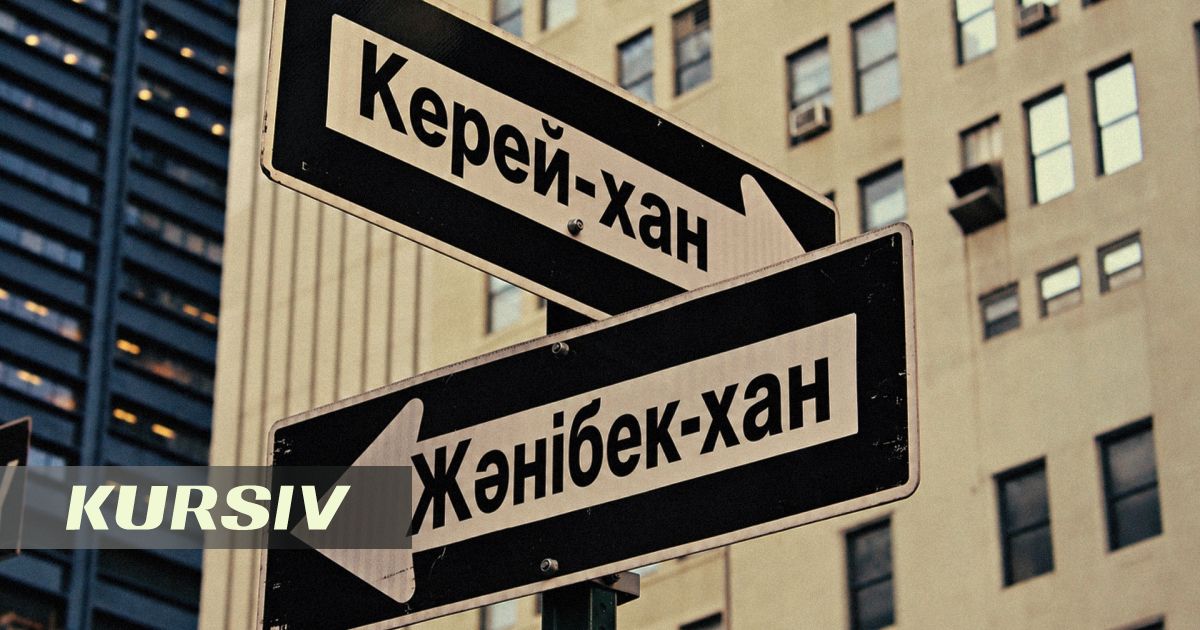
A debate has unfolded on the social network Threads about the practice of giving dual names to streets honoring the khans Kerey and Zhanibek. Users propose splitting them into separate streets — "Kerey Khan" and "Zhanibek Khan" — which they believe would greatly simplify finding the right address on maps, reports infohub.kz.
Kazakhstanis are expressing bewilderment: why weren't two different streets found for the great khans who founded the Kazakh Khanate? As users note, this is not just about assigning names to geographic objects, but about respect for the individuals who laid the foundations of statehood.
"If we follow the logic of assigning such names to streets, then we could give one street for two — Aliya and Manshuk, one street for three — Gani Muratbayev, Alibi Zhangildin and Lenin, and for Mukanov, Musrepov and another 6–7 writers," wrote a commentator.
"That's true, we could have given two parallel streets," a Kazakhstani agreed.
One resident of Aktobe emphasized that in the city, two separate streets are named after Kerey and Zhanibek. Commenters urged authorities to follow this example in other cities across the country.
"The khans who laid the foundations of the Kazakh nation should be given the most important street," added the author.
"In Almaty, this street of the khans Kerey and Zhanibek goes all the way to Shymbulak," a user recalled.
Other commenters, however, were skeptical about the proposal to split the streets. They note that cities have more important problems than renamings, and the initiative itself would require additional financial costs.
"They created one state together," a user commented.
"Stop it, there are other problems. The streets are not empty, there are enough of them. They don't need to be split," the author clarified.
However, Kazakhstanis agreed that if two different streets had been named after the khans, navigating cities would be much easier.
Earlier, "Kursiv" wrote that an archival photo of Alikhan Bokeikhanov attracted Kazakhstanis on social media. Users noticed a watch on his wrist and calculated that today such an accessory could cost tens of millions of tenge.