

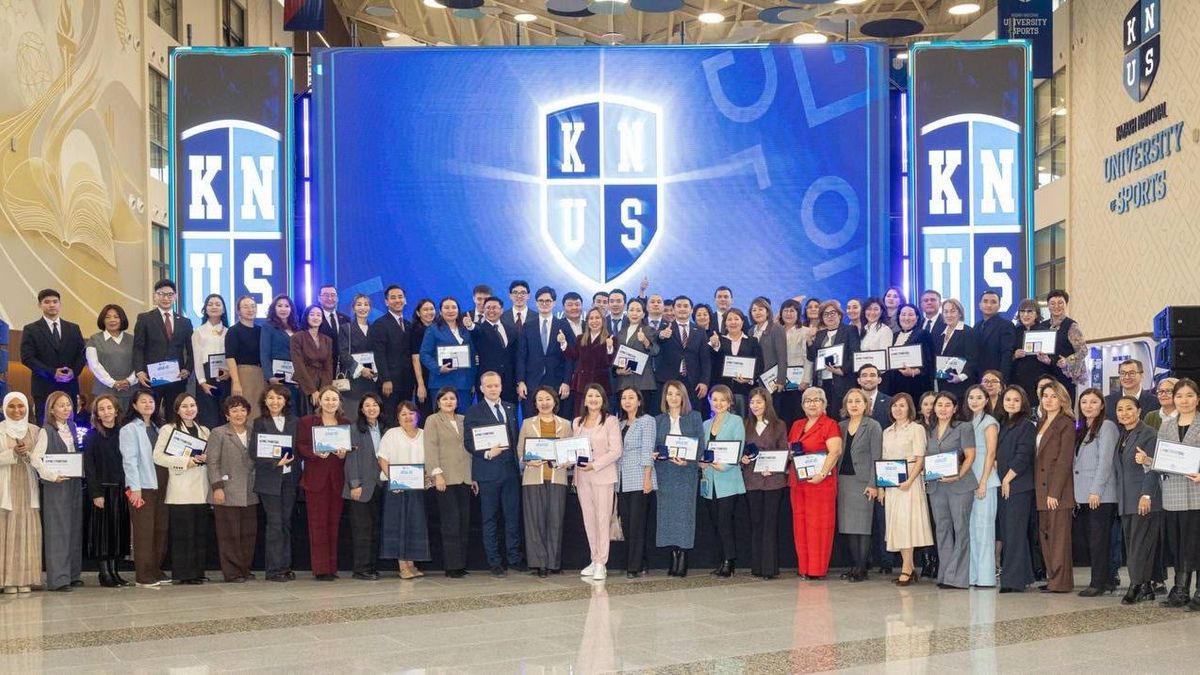
Kazakhstan has received an unusual gift — a working university with thousands of students, modern educational infrastructure and achievements in elite sport. Nurasyl Medeu, founder of the Kazakh National University of Sport (KNUS), has decided to transfer the institution to the state after spending five years and his own money building and developing it, infohub.kz reports.
The decision was announced on 17 October in Astana, where KNUS was marking the fifth anniversary of its founding. During a ceremony, Nurasyl Medeu and Talgat Yeshenkulov, Vice-Minister of Science and Higher Education of the Republic of Kazakhstan, signed the relevant document.
For a university that began with just 150 students, the anniversary proved especially symbolic. Today it enrolls around 5,000 people, and KNUS is gradually becoming one of the more prominent players in Kazakhstan's sports education system.
The creation of a specialised sports university was initially a private initiative of Nurasyl Medeu. The idea was to build an educational environment where professional athlete training would be combined with academic knowledge, research and modern technology.
Over five years the project expanded considerably. Today the university develops academic programmes, sports science and digital fields, including the use of artificial intelligence.
Its sporting results speak for the work as well. KNUS athletes have won 14 Asian Games medals. The university also provides a free training base for Kazakhstan's national teams, contributing to the preparation of high-level athletes.
Access to education remains an important focus. Through the Life Chance Grant and Life Merit Grant programmes, talented young people, including those from the regions, are able to study on scholarships.
At the anniversary event the tradition continued: outstanding students received educational grants, and faculty members were recognised with certificates of honour.
The decision to give the university to the state deserves particular attention. This is not a financial donation or a one-off charitable act, but a fully functioning educational institution that already operates, teaches students and has its own infrastructure.
The approach reflects a particular philosophy of philanthropy: first build a socially significant project, ensure its development, and then give society the result of years of work.
Nurasyl Medeu's act can be seen as a striking example of modern Kazakh philanthropy, in which personal initiative and private capital are directed at the country's long-term goals.
At the same time, the value of such a gift is not measured only by the money invested. What matters most is the opportunities the university creates for future professionals, athletes and young people who tie their lives to sport.
The gift to the state opens the next stage of development for the university. In its first five years KNUS went from a small educational project to an institution with a student community in the thousands and sporting achievements of its own.
The university now faces new tasks: expanding educational opportunities, developing its research base and training qualified personnel for the sports sector.
The KNUS story shows how a private initiative can grow into a project of national importance. And its founder's decision to give the university he built to the state lends the story particular meaning: the result of personal investment becomes a contribution to the future of Kazakh education and sport.