

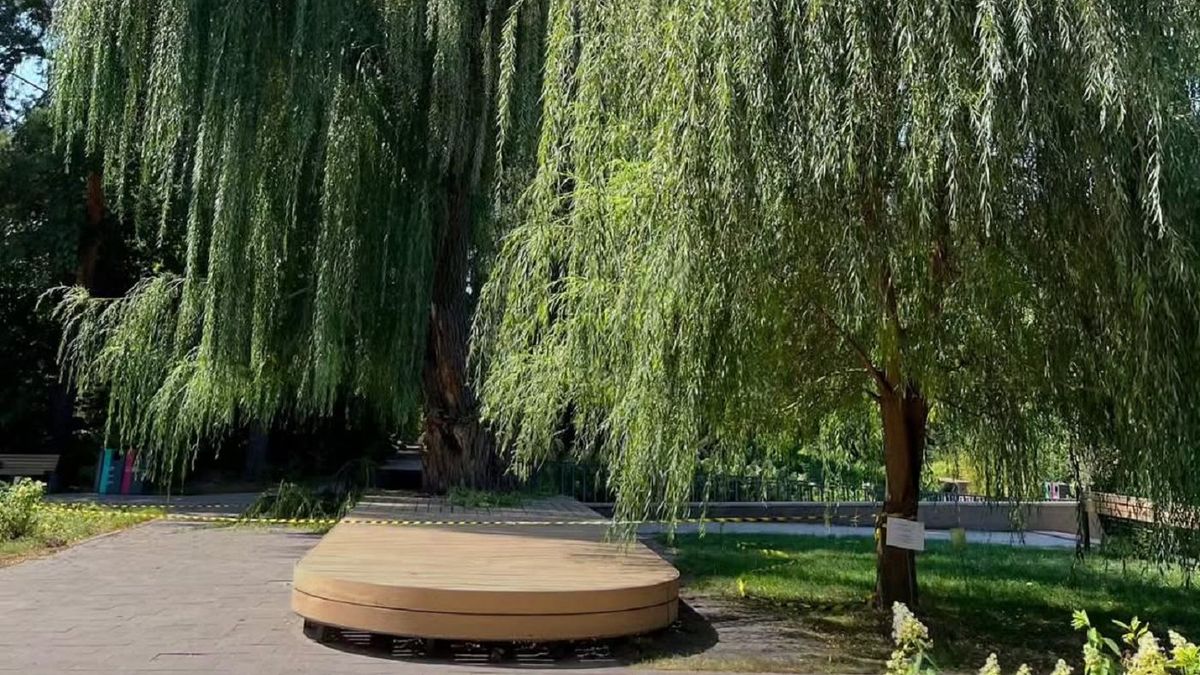
In Almaty, the famous willow that had stood in the Botanical Garden for 72 years has been dismantled. Garden specialists explained why the tree had to be removed, reports infohub.kz.
As reported on the Botanical Garden's Instagram account, on June 16, strong winds damaged one of the most famous willows, breaking off a large part of the trunk over 10 meters long. "The fall damaged a fence and part of the pedestrian curb. Fortunately, no visitors were injured. A detailed examination of the tree by specialists revealed serious age-related changes. These hidden defects, combined with extreme wind load, led to the breakage," the garden explained.
The tree in question is a Babylon willow (Salix babylonica) that had been growing in the garden since 1954. It was obtained as cuttings from Karaganda and for over seven decades was part of the scientific collection of the Institute of Botany and Phytointroduction and one of the garden's most recognizable landmarks.
"Despite the willow retaining its decorative appearance, the examination revealed internal damage: a deep hollow at the base of the trunk, bark detachment, damage from stem pests, and rotting of the core. For old trees, the external appearance does not always reflect their true internal state. (...) According to the commission's conclusion, the remaining part of the willow was declared hazardous and posed a threat of sudden collapse," the Botanical Garden added.
It was noted that preserving the tree through special measures was no longer possible, and further use posed a threat to life and health. "Therefore, a decision was made to dismantle it. On August 31, 2026, the complete removal of the tree (Babylon willow) was carried out, as its safe operational lifespan had come to an end due to age-related changes," the garden reported.
But the story of this tree continues. As early as 2022, a young willow was planted next to the old one. According to specialists, it has now noticeably strengthened and is in an active growth phase. The successor willow will continue the story of its predecessor and over time will assume the status of the new symbol of the Botanical Garden.