

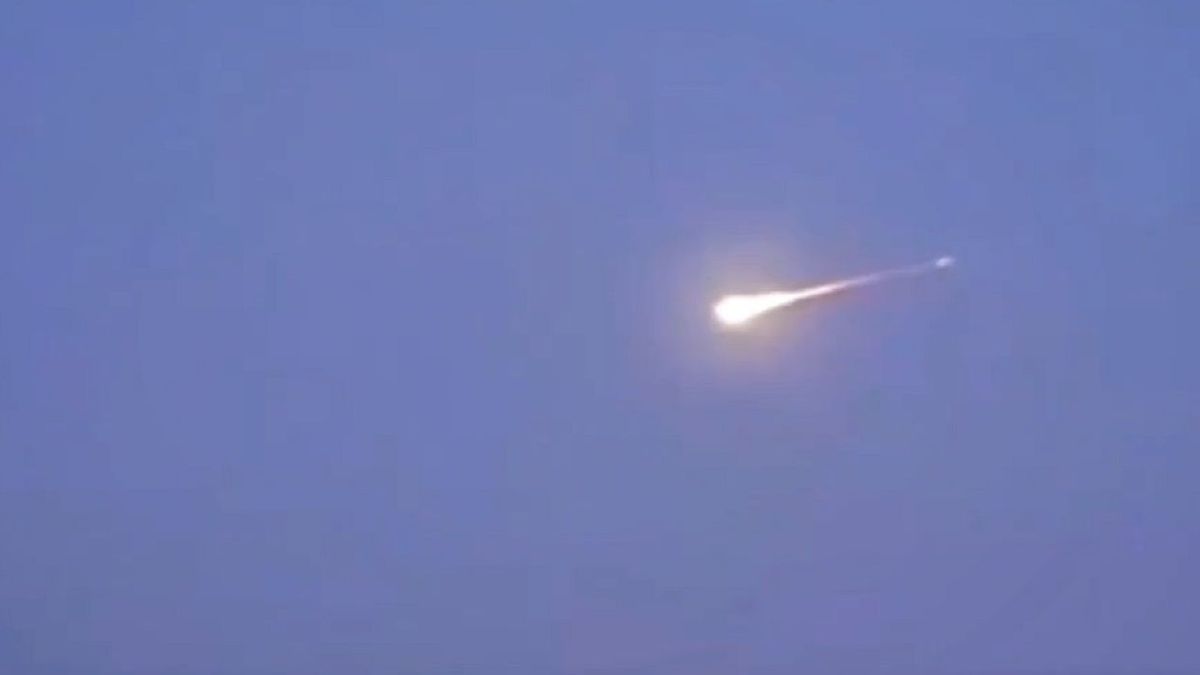
The familiar idea that falling space rocks simply vaporize from colossal friction and heat on atmospheric entry turns out to be wrong. A team of astronomers led by Dr. Peter Jenniskens of the SETI Institute and NASA's Ames Research Center analyzed video recordings and photometric light curves from 75 documented meteorite falls, infohub.kz reports.
In a study published in the journal Meteoritics & Planetary Science, the researchers identified seven successive physical stages that govern mass loss, deceleration and the way fragments strike the ground. Melting and early fragmentation, rather than friction-driven evaporation, determine the trajectory and explosive behavior of asteroids, the researchers showed.
The first stage is shock wave formation. At high altitude, air density becomes sufficient to form a shock wave ahead of the object. The gas and the body's surface heat up, producing the glow of a classic shooting star.
The second stage is entry into denser layers and rotation. The glow intensifies as the object descends deeper into the atmosphere. Periodic brightness fluctuations at this stage make it possible to measure the rock's spin rate: among the fastest objects studied, a full rotation took between 0.5 and 5 seconds.
The third stage is fireball formation and active melting. The high-speed incoming flow begins stripping molten material from the rock's surface. Droplets of melt break away and vaporize behind the body as a trail.
The fourth stage is stabilization of ablation at an altitude of about 60 kilometers. Here the melting process reaches a quasi-equilibrium: the fireball's brightness levels off or rises gradually. Through melting and the shedding of droplets, the body can lose up to 40% of its original mass.
The fifth stage is early mechanical fragmentation. Growing air pressure begins to crack the rock. An unexpected finding was that breakup begins at aerodynamic pressure amounting to just one-fifth of the mechanical strength of surviving meteorites. The cause is thermal stress and internal cracks the body acquired while still in space. At this stage the speed drops sharply. While the rear of the rock remains intact, a low-pressure zone forms behind it, drawing in small fragments and creating a narrow debris strewn field on the ground.
The sixth stage is the final explosion — the breakup of the rear section. When the back of the rock finally splits apart, a bright flash occurs: a fireball explosion. Because the body has already slowed considerably, this flash glows red, unlike the greenish hues of earlier stages. Large fragments weighing more than 20 grams fly outward at high relative speed.
The seventh stage is dark flight and landing. The remaining pieces keep decelerating, stop melting and become coated in a thin fusion crust. Having lost their visible glow, they travel through the lower atmosphere, are pushed by the wind and land on the ground as meteorites.
The authors stress that potentially hazardous asteroids up to several tens of meters across, including the 2013 Chelyabinsk asteroid, pass through these same physical phases. The resulting mathematical models will help calculate the altitude and force of atmospheric explosions of space bodies more accurately when assessing planetary safety.