

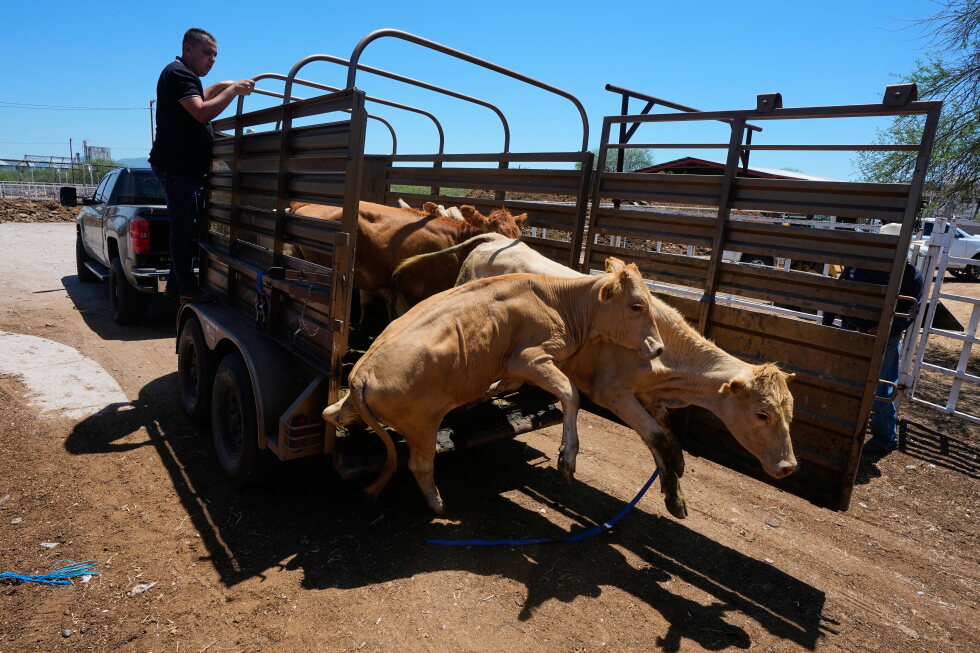
Mexico has resumed live cattle exports to the United States after a nearly two-year halt, marking a significant event for the country's livestock industry. This was reported by infohub.kz.
The exports were suspended due to restrictions imposed by the former U.S. administration following an outbreak of screwworm, a parasite that affects cattle. The disease is now present on both sides of the border. Despite strict requirements, the reopening of the trade channel has brought relief to Mexican ranchers.
In the desert mountains along the U.S.-Mexico border, hundreds of cattle began crossing from the town of Agua Prieta in the state of Sonora to Douglas, Arizona, at around 3 p.m. on Friday. The process began after several hours of inspections by Mexican and U.S. authorities, who used dogs to check each animal for screwworm infection.
The parasite is caused by larvae of the Cochliomyia hominivorax fly, which invade open wounds or mucous membranes of any warm-blooded animal, including humans, and devour tissue, leading to deep and painful wounds.
The pest arrived in Mexico in November 2024 and is now present in 30 of the country's 32 states, including the northern state of Sonora. In the United States, the first cases were reported in June in Texas and New Mexico.
Mexican President Claudia Sheinbaum welcomed the reopening on Monday morning, and her administration plans to intensify measures to combat the outbreak. These include improving cattle tracing systems and continuing to release sterile flies in border states like Sonora and Chihuahua, which are major exporters of cattle to the U.S. Mexico currently has 1,937 active screwworm cases.
To resume exports, the U.S. approved a new protocol that includes placing radio-frequency identification tags in the cows' ears and installing scanners to detect these tags. Additionally, cattle crossings into Arizona are limited to 700 head per day, increasing to 900 next week and 1,300 the following week.
While Mexico has hundreds of cattle ready for export, the U.S. restrictions will slow the industry's recovery, leaving U.S. cattle herds at their lowest levels in 75 years, with a shortfall of about 1.2 million head, leading to a surge in beef prices.