

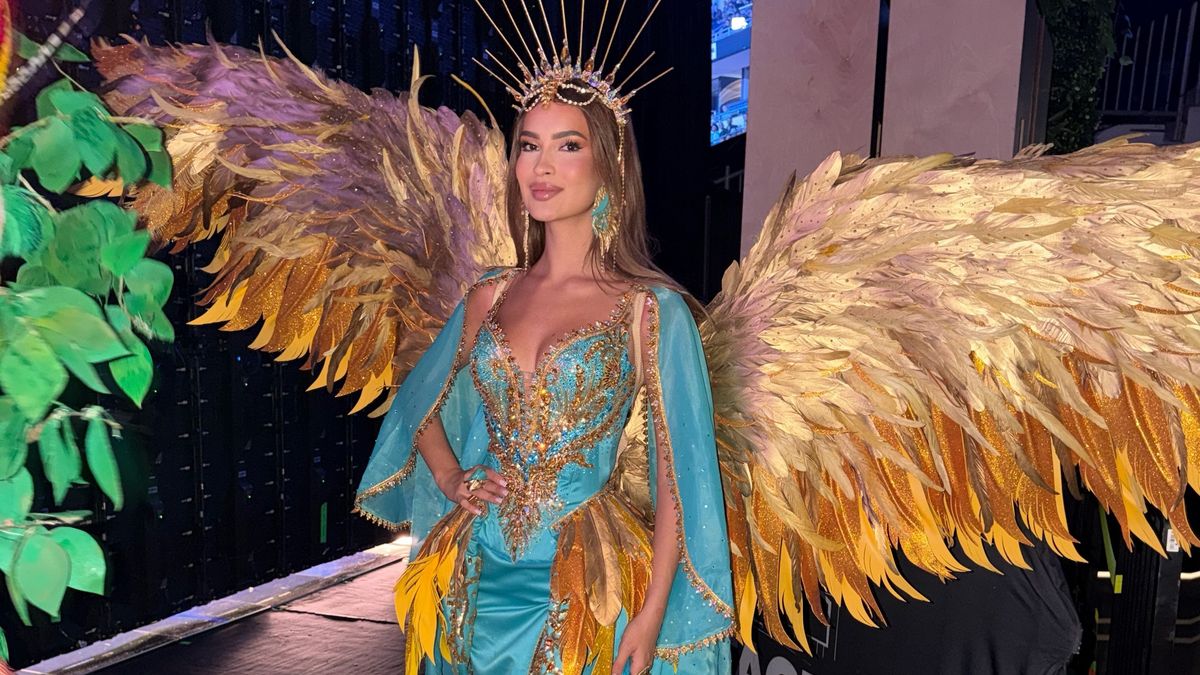
A debate has erupted on social media over the national costume worn by Kazakhstan's representative Alina Ri at Miss Universe 2026, with some comparing the look to the outfit worn by a contestant from Kyrgyzstan in 2025, infohub.kz reports.
According to the Miss Kazakhstan Instagram account, Alina Ri represented the country at this year's Miss Universe 2026 pageant. On November 21, she took part in the National Costume Show, where she presented the national outfit. The standout feature of her look was a pair of mechanical golden eagle wings with a wingspan of 4.5 meters.
"The golden eagle in this look symbolizes the strength and independence of Kazakhstan, while the golden lace represents the wealth and abundance of our country," the statement said.
The costume took six months to create, according to the post. The embroidery was done by hand, as was the inlay of more than 10,000 stones. The look was completed with natural feathers and a five-meter train.
"The dress is magical," "What a beauty," "Alina, you look gorgeous in this look," "Alina's costume embodies the flag of Kazakhstan," social media users wrote under the video.
Not everyone, however, reacted so enthusiastically to Alina's look. Some wrote on Threads that the wings had been copied from the outfit worn by the contestant from Kyrgyzstan at Miss Universe 2025.
Kazakhstanis also recalled that the country had already appeared at the pageant in a winged look, and earlier than Kyrgyzstan — in 2018.
User amisaint noted that Kazakhstan was not the only country to feature a winged costume at the pageant, pointing to Belgium, Egypt, Germany, Kenya, Montenegro, Serbia, Trinidad and Tobago and the Virgin Islands.
Miss Kazakhstan director Ramina Ibragimova responded to the online debate.
"What nonsense is it to compare Kyrgyzstan's costume at Miss Universe 2025 with Kazakhstan's for 2026? The costumes are completely different, with zero similarity apart from the wings. If you look, wings are used by virtually every country, as it is a popular symbol. But the costumes are totally different in identity, even the silhouettes," Ibragimova wrote.
In comments under posts on the subject, participants in the discussion urged others not to let the dispute over the costumes affect relations between the two peoples.