

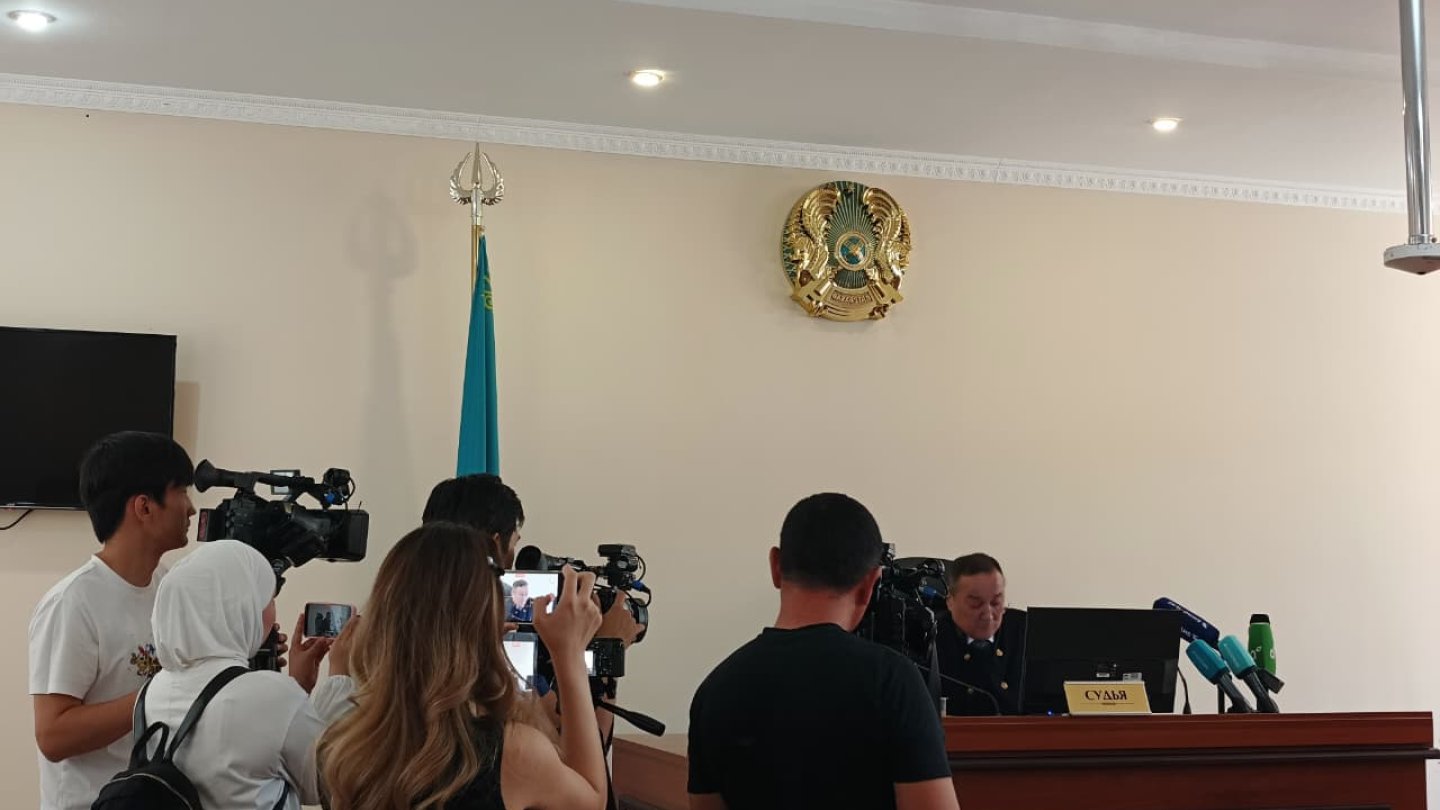
Preliminary hearings in the murder case of 21-year-old Nurai Serikbay in Shymkent were postponed due to the defendant's illness. Before the recess, however, both sides filed opposing motions: the defense objected to photo and video coverage, while the victim's family requested the trial be held as openly as possible, with media access and a live broadcast, according to infohub.kz.
The presiding judge read a medical certificate stating the defendant was unable to attend due to illness. The preliminary hearing was adjourned because the defendant must decide whether to have the case heard by a jury and express his opinion on a live broadcast. He remains in a pretrial detention center.
Ayan Omarov, a lawyer representing the victim's family, said the family insists on maximum transparency because the case has drawn widespread public attention. The charges involve offenses that were criminalized shortly before the tragedy.
“Today we filed a motion to allow the media, as this is an open court proceeding. The case has attracted great public attention from the start. We want society to know what circumstances will be examined in court and what evidence will be presented. This is not an attempt to pressure the court or manipulate public opinion — it is the wish of Nurai's family. People need to understand what stalking and forced marriage are, know their rights, and understand the consequences of such crimes,” the lawyer said.
The victim's side also seeks to have Nurai's brother, Sultan Serikbay, recognized as the victim's representative. “Nurai's father works on a rotational basis. He is not always able to attend court hearings. So we asked that her brother be recognized as the victim's representative. Furthermore, we intend to resubmit a motion to bring the defendant's close relatives to criminal responsibility. The case file contains information that, in our opinion, directly or indirectly indicates their role in forcing Nurai into marriage. Video footage shows the girl being brought to a house, having a headscarf put on her, and being persuaded to stay. We believe no physical violence occurred at that moment, but she was subjected to serious psychological pressure. In our view, one person could not have organized everything that happened alone,” the lawyer said.
Asked by reporters what circumstances the investigation considers stalking, the lawyer explained that the harassment began after Nurai's rejection. “First, there was the forced marriage attempt. After the defendant was refused, he began stalking Nurai. According to the case file, that is when the stalking started. He called her, causing Nurai to change her phone number several times, and he contacted her friends and classmates,” Omarov added.
Sultan Serikbay, the victim's brother, said he is currently a witness in the case but hopes the court grants the motion to recognize him as the victim's representative. “We have reviewed the case materials. The defendant was represented by four lawyers, but none of his relatives came. The judge read a medical certificate about the defendant's illness. This is my personal opinion, but I believe he is faking it,” Sultan Serikbay said.
The victim's family intends to seek the maximum penalty allowed by law: life imprisonment.
The defendant has been charged with stalking, forced marriage, and murder committed with extreme cruelty. According to legal experts, in such cases the final sentence is usually determined by the most serious charge. If the defendant is fully proven guilty, he could face life imprisonment. If the court does not impose the maximum sentence, he could receive a long prison term of more than 20 years.
On the evening of January 11, 2026, in Shymkent, 21-year-old Nurai Serikbay was attacked at a pedestrian crossing at the intersection of Tolemetov and Utegenov streets. The incident was captured by surveillance cameras: the footage shows the girl trying to run away and resist, but a man catches up, beats her, and stabs her multiple times before fleeing. Nurai died at the scene from her injuries. The suspect was later arrested, and the investigation sparked widespread public outcry. The charges were later expanded to include stalking and forced marriage. Following the incident, Kazakh President Qasym-Jomart Toqaev ordered a review of the actions of Shymkent's police department. As a result, the head of the Shymkent police department and his first deputy were dismissed.