

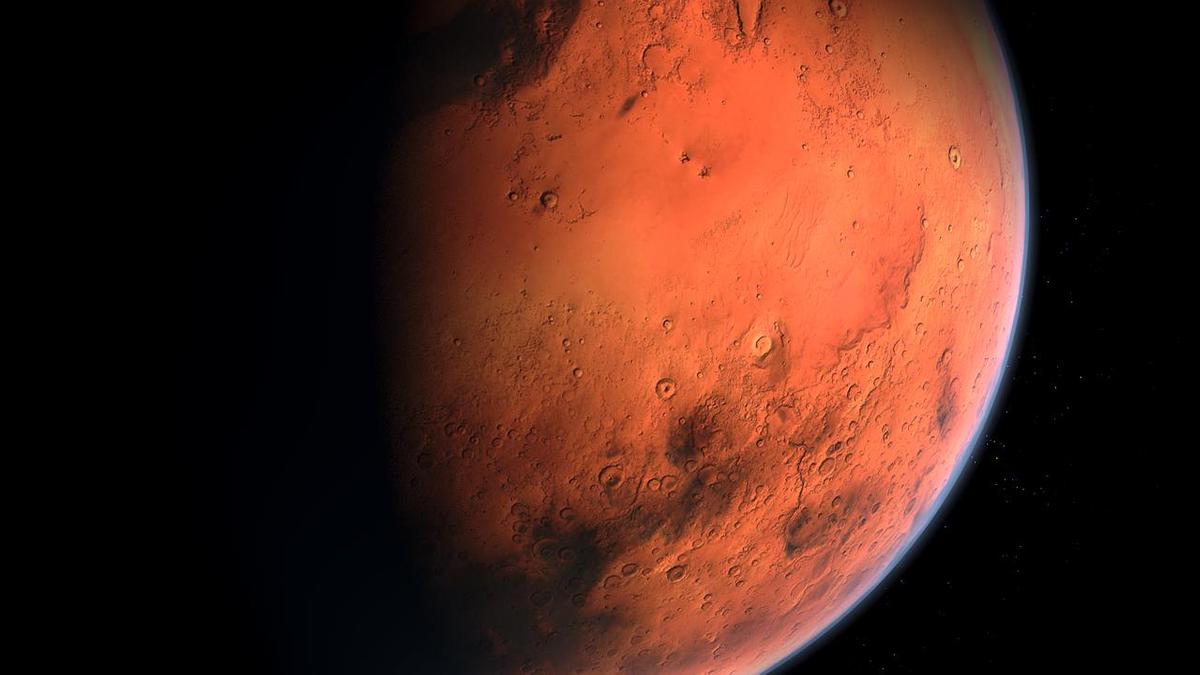
Seismic data from NASA's InSight lander has revealed a vast magmatic system deep beneath the Martian surface, reports infohub.kz.
Researchers at the University of Oxford have found evidence of giant magma chambers in the depths of the Red Planet. The findings, published in the journal Nature Astronomy, challenge current understanding of Mars' geological evolution.
Previously, scientists believed Mars' geology was relatively simple, as the planet lacks plate tectonics—the process on Earth that drives continental drift, volcanic eruptions, and the recycling of rocks. Analysis of seismic data from NASA's InSight probe revealed a distinct boundary at a depth of about 24 kilometers beneath the Martian surface.
The team compared seismic wave patterns with hundreds of possible rock compositions. They found that below this boundary, ultramafic rocks rich in iron and magnesium dominate, while above it, mafic rocks with higher silica content prevail. This structure suggests that molten magma accumulated over time, separated into different fractions, and recycled the Martian crust.
According to the study's authors, this buried magmatic system could extend for hundreds to thousands of kilometers across Mars' northern hemisphere. Lead author Tobermory MacKay-Sampson noted that "transcrustal magmatism," previously thought to be unique to Earth, also occurred on Mars.
Co-author Professor John Wade emphasized the importance of this discovery for the search for potentially habitable exoplanets. If a planet can form a complex crust and sustain geological recycling without plate tectonics, conditions for life may arise on far more celestial bodies than previously thought.