

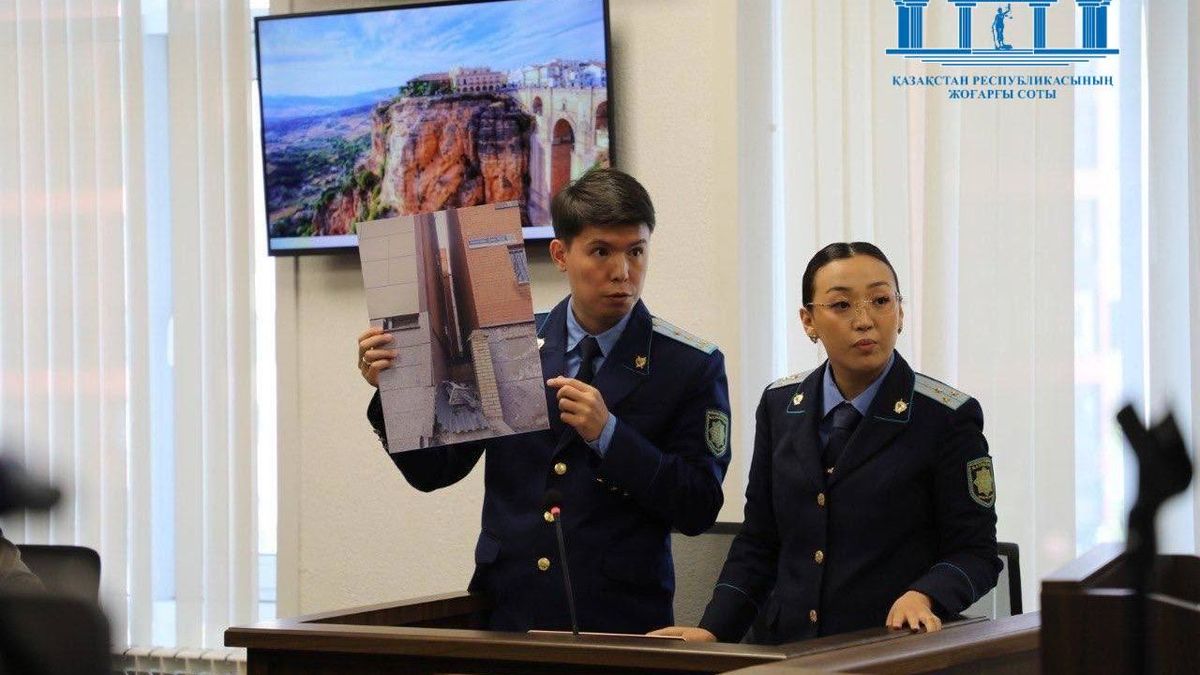
In court over the death of Uldana Myrzuan, an expert testified that the building's facade collapse could not have been predicted through visual inspection, reports infohub.kz.
Baurzhan Kaziev, invited by the prosecution, stated that the primary cause of the collapse on November 8, 2025, was a combination of structural defects and violations in the construction technology of the external multi-layer brick wall. According to him, it was not a single cause but a complex of factors: lack of required reinforced belts, improper installation of reinforcement meshes, broken connections and anchoring of the facing layer, poor mortar filling of masonry joints, presence of voids, wide cracks, gaps between wall layers, and absence of proper deformation separation and distribution of vertical load on the facing layer.
The expert explained that the failure mechanism involved the loss of composite action between the facing and the main load-bearing layers. The facing layer bore the weight of the rows above without adequate load redistribution or secure attachment to the main wall. Over time, cracks, deformations, gaps, moisture infiltration, and freeze-thaw cycles weakened the masonry, leading to local instability and collapse.
The deterioration process, Kaziev said, was gradual: cracks first appeared, then the layers lost their composite action, gaps and deformations developed, and moisture seeped in. All this negatively affected the structure's stability. The expert stressed that such hidden defects cannot be detected by visual inspection. He noted that cracks were already recorded in 2017, indicating a long-term process, but in the early stages, cracks are not visible; they appear gradually under external influences.
For accurate diagnosis, the specialist said, instrumental technical surveys, geodetic studies, and verification calculations were required. Additionally, specialists needed to be engaged to determine necessary remedial measures, including possible full dismantling of the cladding or reinforcement with metal structures.
Kaziev also refuted suggestions that increasing the building's height from five to nine stories led to exceeding permissible loads. He stated that the foundation's bearing capacity is sufficient for the loads, and the bearing capacity of the longitudinal walls ensures they can handle design loads, including wind, snow, and self-weight.