

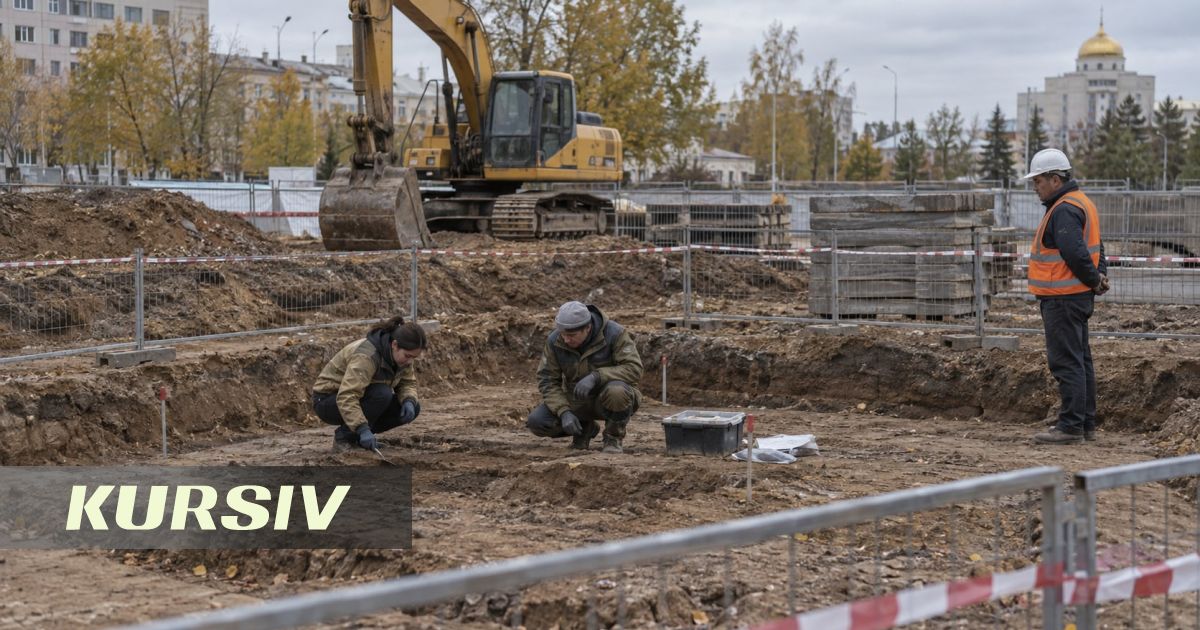
Human remains have been discovered in Petropavlovsk during site preparation for an inclusive center. Work at the site has been suspended, and the remains are to be reburied, according to infohub.kz.
Construction equipment appeared on the site about three weeks ago. Soon workers found skulls, bones, and fragments of burials, after which site preparation was halted.
According to the Astana TV channel, more than a century ago a Christian cemetery was located on this site, and later a young naturalists' station was situated there. The cemetery past of the territory is also indicated by a nearby church.
Priest Antoniy Shuvakin said that work has been suspended since September 11. After discussion, a decision was made to rebury the remains, but by the beginning of the third week the remains had not yet been moved. According to him, both complete skeletons and partial burials were found on the site.
Local historian Oleg Antonov noted that human remains had been found earlier during the construction of other city facilities, but not in such quantities.
The customer for the construction of the inclusive center is the construction department of the North Kazakhstan region, the Petropavlovsk akimat explained. Since the facility is being built on city land, the reburial is being organized by the housing and communal services department.
According to Timur Zhumanov, press secretary of the Petropavlovsk akim, on September 21 the police issued a resolution permitting the reburial of the remains. The contractor of the housing and communal services department must transport them to the cemetery in the Rabochy Poselok area.
The remains are being collected from the surface of the site. Volunteers and church representatives believe that the territory also needs to be professionally examined at greater depth. Police are conducting the necessary measures following the discovery of human remains. The timeframe for resuming construction has not yet been determined.
Earlier, Kursiv wrote that human remains were found at a construction site on the territory of the former Pishchevik stadium in Semey. The bones were sent for examination to establish their origin and the age of the burial. Before that, a similar find was made during the construction of an infectious diseases hospital in Shemonaikha — the remains were decided to be reburied in the existing cemetery.