

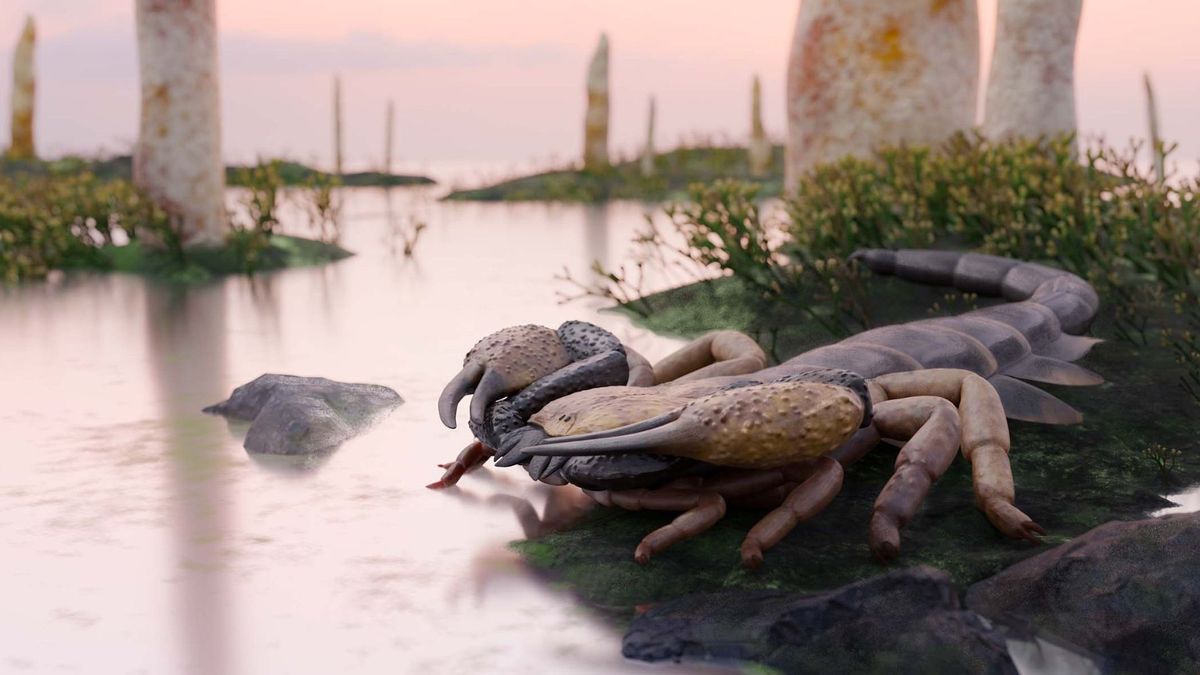
British paleontologists have confirmed that fossils unearthed in the United Kingdom back in the 1870s belong to the largest scorpion known to science in Earth's history — the species Praearcturus gigas. The findings of researchers at the Natural History Museum in London have been published in the scientific journal Palaeontology, infohub.kz reports.
The ancient predator lived about 415 million years ago, grew to more than a metre in length and could hunt both on land and in water. The scientists examined the samples using computed tomography and compared them with the remains of the ancient Canadian scorpion Eramoscorpius, finally pinning down the animal's place on the evolutionary tree.
According to the authors' estimates, the body of Praearcturus gigas exceeded one metre in length, comparable to the size of an average dog. Its claws alone reached 16 centimetres — larger than the body of many modern scorpions. On one of its limbs, the researchers also found comb-like structures that allowed the predator to produce sounds by rubbing parts of its body together (stridulation).
According to lead author and paleontologist Richie Howard, the animal was able to grow to such impressive dimensions thanks to the absence of competition from other large land predators, since the ancestors of reptiles, birds and mammals had not yet emerged from the water at that time. Terrestrial ecosystems were only just forming in that era, so the scorpion led a semi-aquatic lifestyle: fossils from Wales preserve plate-like structures resembling elements of the shells of modern lobsters and crabs.
As study co-author Greg Edgecombe noted, this indicates that the ancestors of Praearcturus gigas returned to the aquatic environment after emerging onto land. The giant scorpions died out roughly 40 million years later, probably unable to withstand competition for food.