

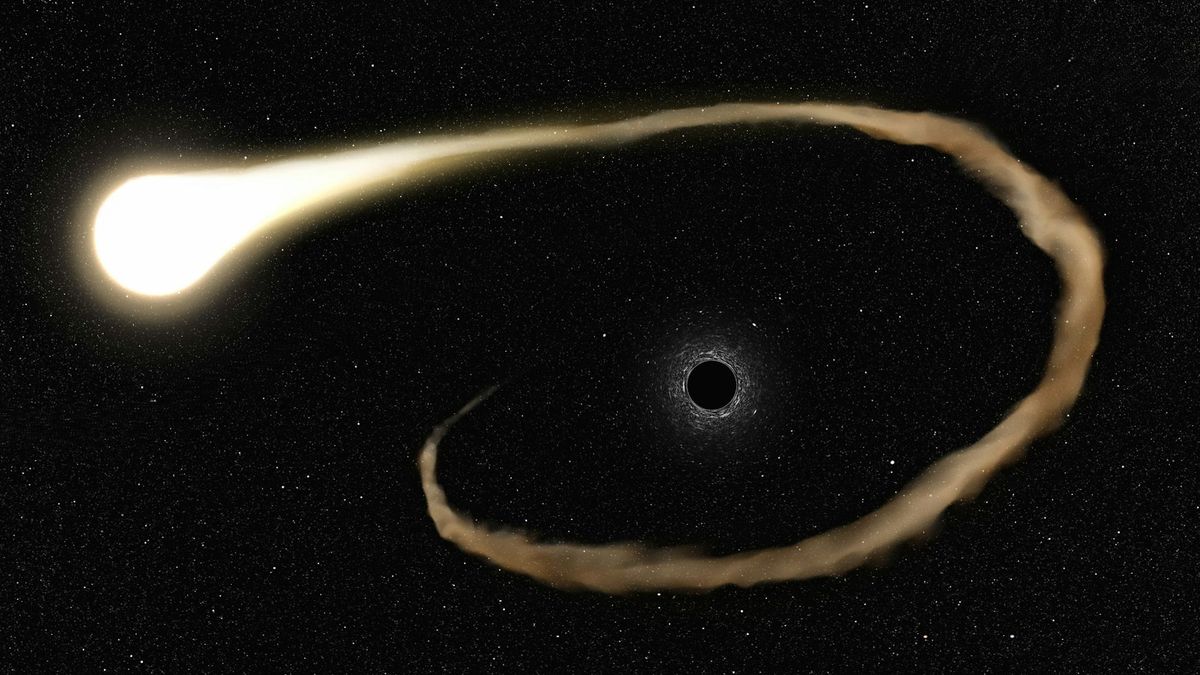
An international team of scientists has found that primordial black holes could trigger explosions of white dwarfs, explaining the chemical peculiarities of stars and supernova remnants in our galaxy, reports infohub.kz.
Hypothetical primordial black holes, formed in the first moments of the universe's existence, are considered by scientists as potential dark matter candidates. Passing through white dwarfs, these objects create powerful gravitational tidal forces that can destabilize the star and initiate an uncontrolled thermonuclear reaction, leading to a Type Ia supernova explosion.
The study, led by Xing-Chi Liu from the Polytechnic Institute of New York University and the Kavli Institute for the Physics and Mathematics of the Universe at the University of Tokyo, was published in The Astrophysical Journal. The research team also included physicists Ken'ichi Nomoto and Alexander Kusenko.
The astronomers compared their models with the remnants of known supernovae Tycho, Kepler, and 3C 397, as well as with the outbursts SN 2011fe and SN 2012cg. Analysis of isotopes of nickel-56, nickel-57, and stable manganese confirmed that such explosions enrich the galaxy with metals and explain the chemical composition of many stars in the Milky Way.