

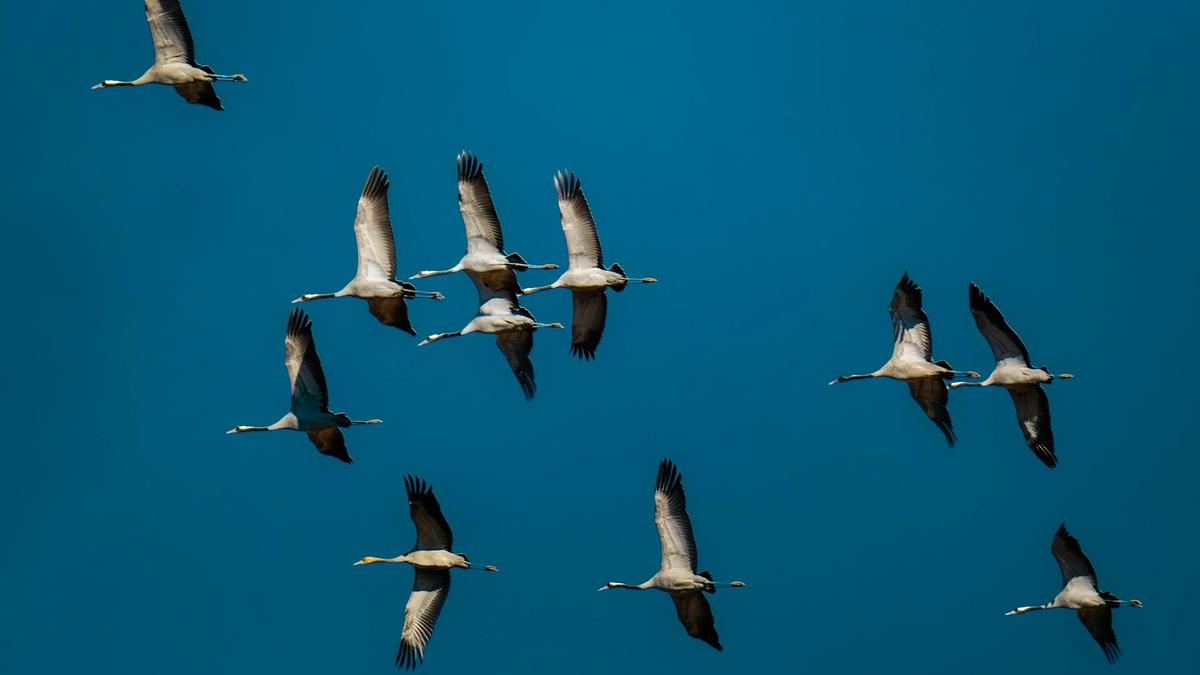
Seabirds suffer from jet lag just like humans: on long flights east or west across the Atlantic, Manx shearwaters veer off course by up to 15 degrees because their internal biological clocks fall out of sync, infohub.kz reports.
Biologists at the University of Oxford have shown that wild seabirds experience natural jet lag that impairs their ability to navigate accurately by the sun's position in the sky. The results of the large-scale study, led by Patrick Lewin, were published in the journal Science.
The researchers focused on Manx shearwaters — pigeon-sized relatives of albatrosses that nest along the coasts of Britain and Ireland and fly hundreds to thousands of kilometres out into the ocean to feed.
To find their way home to their burrows, the birds rely on an olfactory map of the terrain and a solar compass. Because the sun moves continuously across the sky from east to west, the birds need a reliable internal chronometer to keep adjusting their bearing. Shearwaters calibrate their biological clocks at dawn and dusk. In fast flight, for every degree of longitude covered, the bird's internal time falls behind or runs ahead of local astronomical time by exactly four minutes, causing it to misjudge the sun's position.
The scientists pooled 20 years of GPS tracker data, following 3,688 flights by 1,045 individuals. An analysis of 335 direct flights to their nests showed that the deviations in the birds' actual routes matched the predicted compass errors precisely: when flying east, the birds drifted clockwise, and when flying west, counterclockwise. The time shift ranged from 10 minutes to one hour, and the maximum navigation error reached 15 degrees. The birds periodically check against their map and easily correct course, adding only five kilometres to a 1,000-kilometre journey. Studying the birds' resilience to changing time zones could help people cope with the effects of jet lag.