

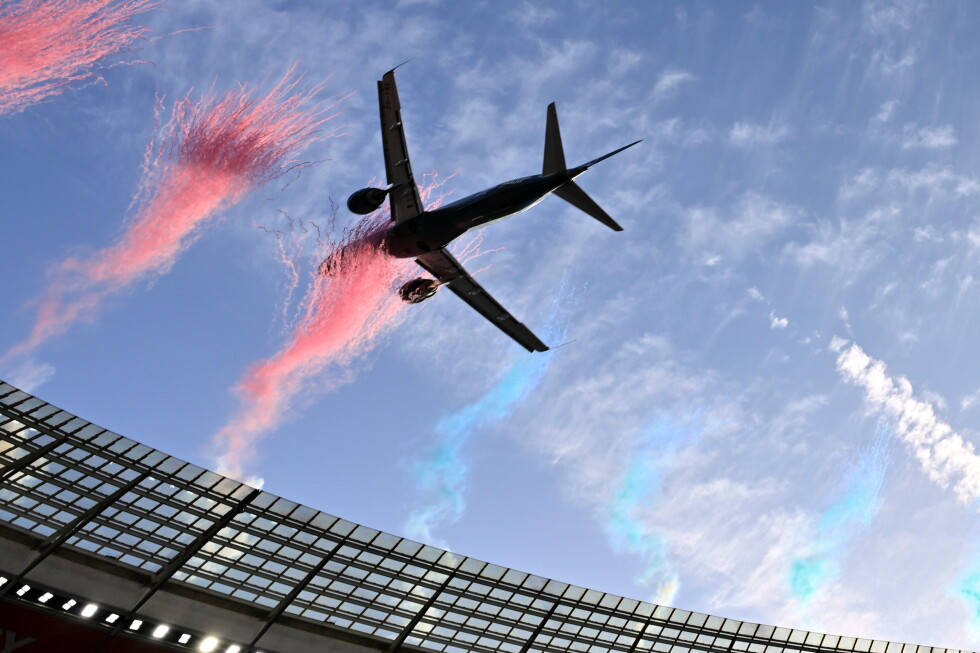
Two passenger jets flying dramatically low over a sports stadium in South Africa drew cheers from nearly 56,000 spectators but also sparked a major debate over safety risks. This was reported by infohub.kz.
On Saturday, before a rugby match between South Africa and New Zealand at Cape Town Stadium, two Embraer jets operated by Airlink performed a flyby. According to Flightradar24, the lead jet passed just 12-14 meters above the stadium roof, while the second jet flew through a cloud of pink dust that rose from the roof as part of the pregame show.
Airlink, a sponsor of the South African rugby team, stated that the flyby was conducted in accordance with safety regulations. The airline said the flight was carefully planned and rehearsed, with the aircraft traveling at approximately 278 km/h over the stadium. Each jet had three senior captains onboard, serving as commander, co-pilot, and safety officer. The jets carried no passengers.
Responding to social media concerns on Sunday, Airlink said the flight required careful planning and rehearsal, as it involved navigating at low altitude at around 150 knots. The South African Civil Aviation Authority and Air Traffic Navigation Services provided guidance and approval to ensure a safe flyby.
South African rugby has a tradition of stadium flybys at big games, starting when a Boeing 747 flew over a stadium in Johannesburg before the 1995 Rugby World Cup final between the same teams. However, this weekend's flyby was especially low and dramatic, drawing global attention.
Some aviation experts questioned whether the margin for error was too small. Chris Martinus, president of the Aircraft Owners and Pilots Association South Africa, told AP that the lead aircraft was "kind of like dodging over the roof and climbing over the one side and dipping below and then climbing over the other side. That was a little bit uncomfortable." He added that at such an altitude, pilots have no options if something goes wrong.
Keith Tonkin, an Australian aviation consultant and former military and commercial pilot, warned that the Embraer jets were not designed for such low-level operations and that this could set a dangerous precedent. He noted that turbulence or a bird strike at low altitude could leave pilots with too little room to maneuver without hitting the stadium.
Airlink said that flight data from both aircraft confirmed that their flights were within civil aviation safety limits for speed and altitude.