

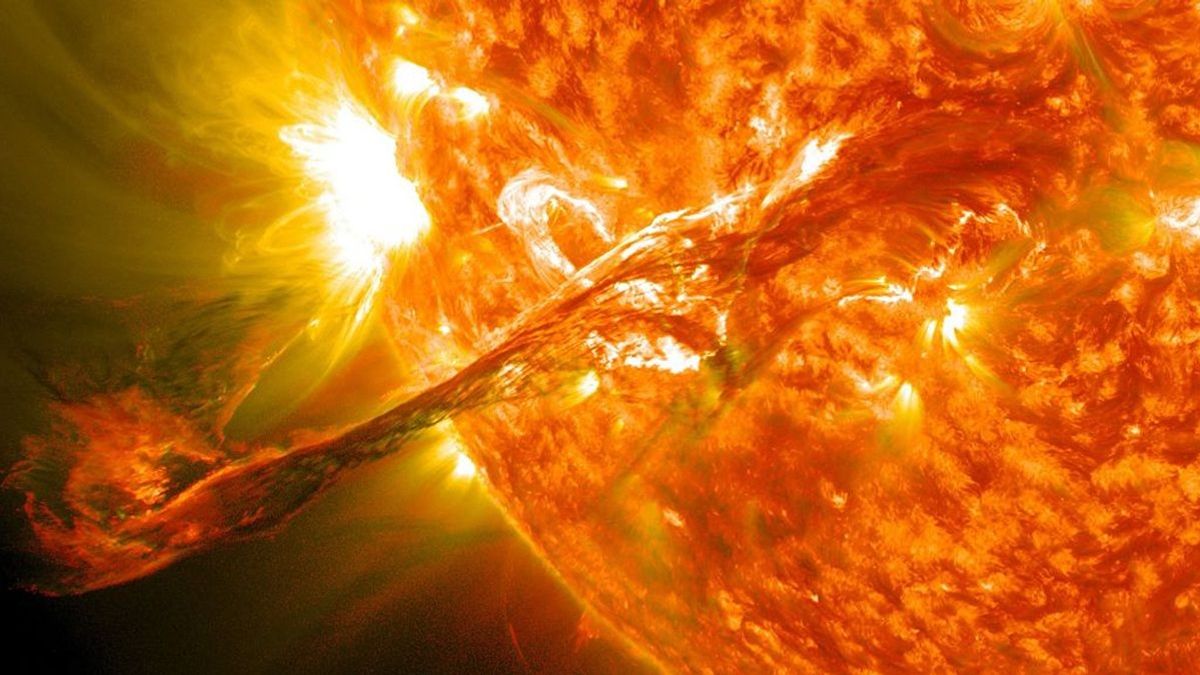
The Sun has seen its largest burst of activity in a month — a series of new flares began in the evening after a nearly month-long lull in solar activity, with one reaching M1.0, according to infohub.kz.
According to the Laboratory of Solar Astronomy at the Space Research Institute of the Russian Academy of Sciences, images of the Sun arriving from space clearly show two large groups of sunspots currently forming at the center of the visible solar disk.
"Apparently, the energy associated with them is what is now being burned off on the Sun. The current level of flares does not yet pose a threat, but it may be a sign of a long-awaited turning point in solar activity," the laboratory said in a statement.
Experts note that since late summer the star has been in a deep lull, unexpectedly strong for the current stage of the solar cycle. This has prompted speculation about a possible earlier onset of solar minimum, which had been expected only in 2029–2030.
"It can be noted that the rate at which new sunspot groups are growing is quite impressive. If this growth continues for another couple of days, by midweek we could see X-class flares. The latter, especially given that the active regions are located at the very center of the solar disk directly facing Earth, could put serious pressure on the planet," the laboratory added.
Assessing the likelihood of such a scenario, however, remains difficult. Today will be decisive, when the growth of active centers either stops or continues, coming close to the threshold for breaking through X2.