

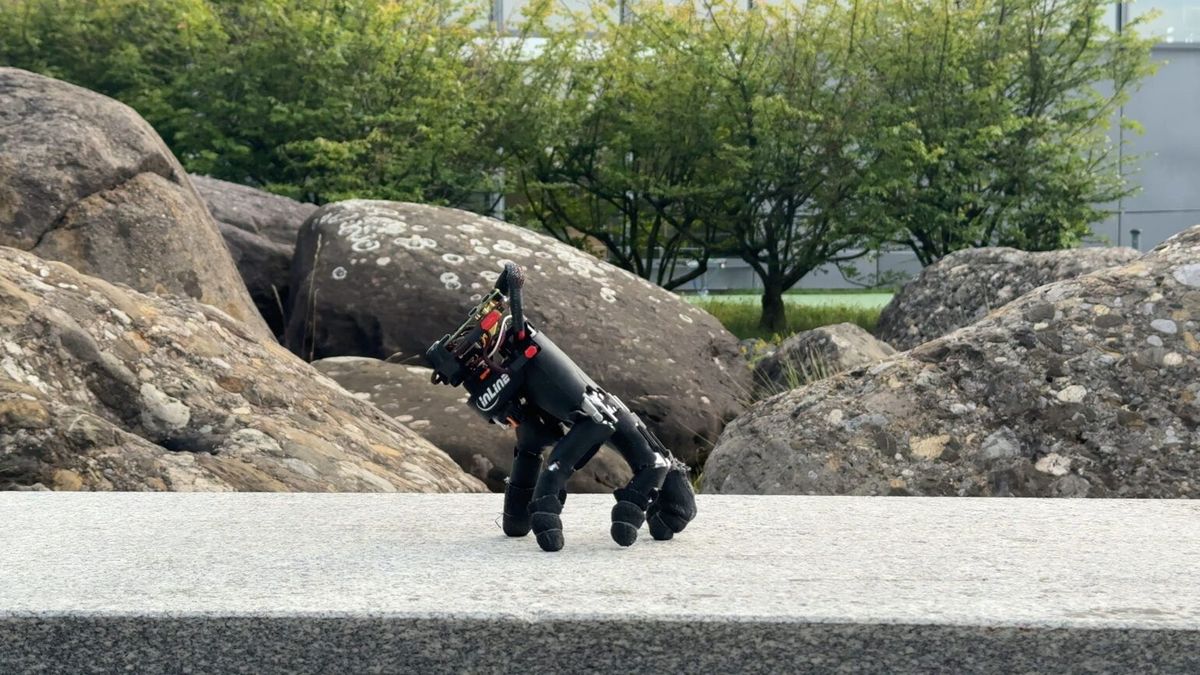
Researchers at ETH Zurich's Soft Robotics Lab have built an autonomous robotic hand that can move on its own fingertips, get back up after falling and press keys on a keyboard, the website infohub.kz reports.
The study by a team led by Amirhossein Kazemipur, Hehui Zheng and Robert Katzschmann has been published as a preprint on arXiv. In the future, the technology could allow large robots to detach a hand and send it into narrow crevices, ventilation ducts or collapsed structures to inspect them, flip switches or move objects.
Building a walking limb was complicated by the fingers' unequal lengths and the thumb's sideways position, which made it hard to keep balance. The engineers took a commercial WUJI robotic hand and mounted a battery, a microcomputer and a motion sensor on its back. The whole assembly weighs 818 grams. The movement control was developed in simulation using reinforcement learning: the system earned points for moving forward and was penalized for dangerous swaying.
In tests, the device reached an average speed of 9.3 centimeters per second and successfully traversed 14 types of surfaces, including parquet, metal grates, gravel and grass, navigating without cameras. The hand also managed to right itself onto its fingers in 21 of 25 test falls. The developers also taught the robot to lift one finger off its support: in 29 of 32 attempts it correctly pressed the right keys on a computer keyboard to play the puzzle game Sokoban. With the help of an external camera, the hand also managed to approach a cube and push it out of place. The researchers next plan to equip the hand with built-in cameras and a docking mechanism for attaching to the main robot.