

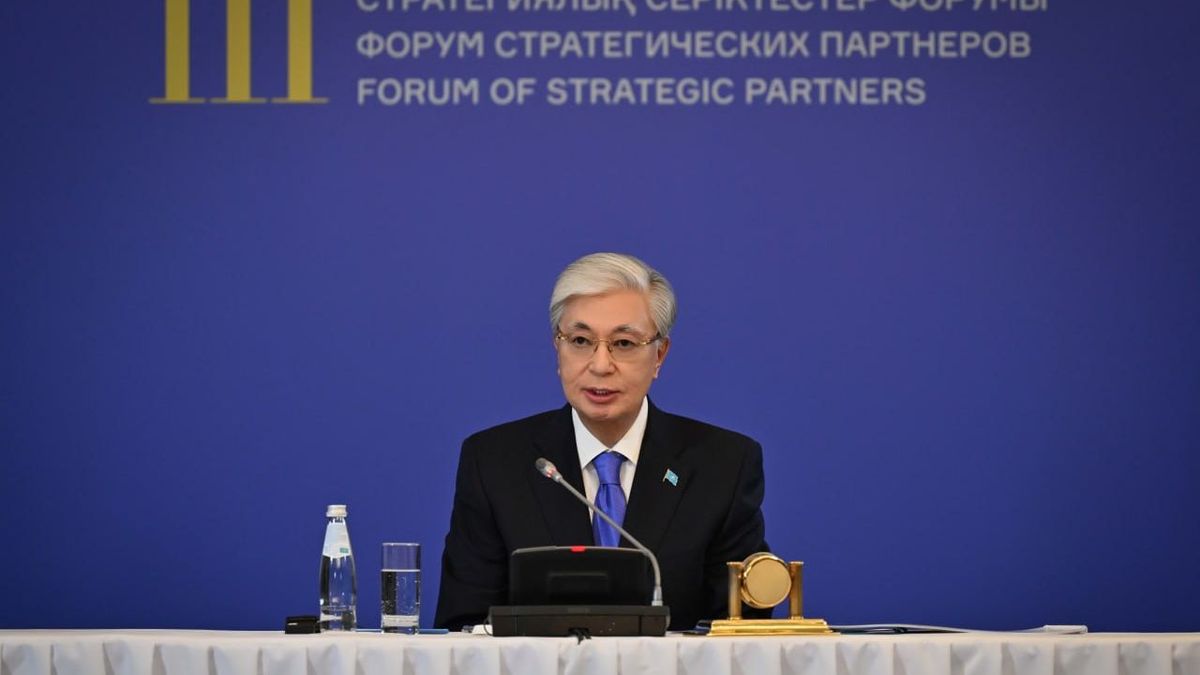
President of Kazakhstan Qasym-Jomart Toqaev took part in a roundtable with heads of international organizations and leading foreign universities, where he said that partnerships in education and science must be taken to a qualitatively new level, the website infohub.kz reports.
According to the head of state, current geopolitical tensions are affecting the fields of knowledge and technology, and scientific cooperation is increasingly viewed through the prism of security. "Cutting-edge achievements are less and less often seen as a common asset and are increasingly becoming an instrument of competitive struggle. This is happening at a time when knowledge and technology are becoming the main drivers of development. Artificial intelligence, new materials, energy and biotechnology are transforming the economy, the labor market and the education system itself," Qasym-Jomart Toqaev said.
The president stressed that only those countries capable of generating new knowledge, training qualified personnel and turning scientific ideas into technology will succeed.
"We position ourselves as a responsible member of the international community and a link between different regions. Developing human capital and advancing education, science and innovation are key areas of the national strategy. I would like to emphasize once again that, for the first time in our history, these priorities are enshrined in the Constitution as a strategic direction of the state's activity. In my address to the people of Kazakhstan this year, I focused attention on the need for accelerated technological renewal, stronger links between science and industry, and preparing our citizens for the conditions of the new digital economy. Achieving these goals requires not isolated initiatives but consistent and coordinated efforts by the state, universities and business," the head of state noted.
Qasym-Jomart Toqaev said Kazakhstan is always open to cooperation with the world's leading universities and research centers. "As you can see, the initial stage of this work has already been completed. The necessary infrastructure has been created, partnership agreements have been formally concluded, and the full operation of branches of foreign universities is expected to begin in the very near future. The next step is to fill our cooperation with real substance through joint research, the development of new technologies and the introduction of practical solutions that meet the needs of our economy," the president said.
In this context, the head of state identified priority areas for cooperation. "First of all, this is water security. For Central Asia, this is a matter of economic and social stability. I would even say it is a matter of our survival. Managing transboundary rivers, creating modern monitoring systems, introducing water-saving technologies and developing science-based water diplomacy require pooling the expert potential of different countries. In this work, we are counting on the experience and capabilities of the United Nations University," Qasym-Jomart Toqaev said.