

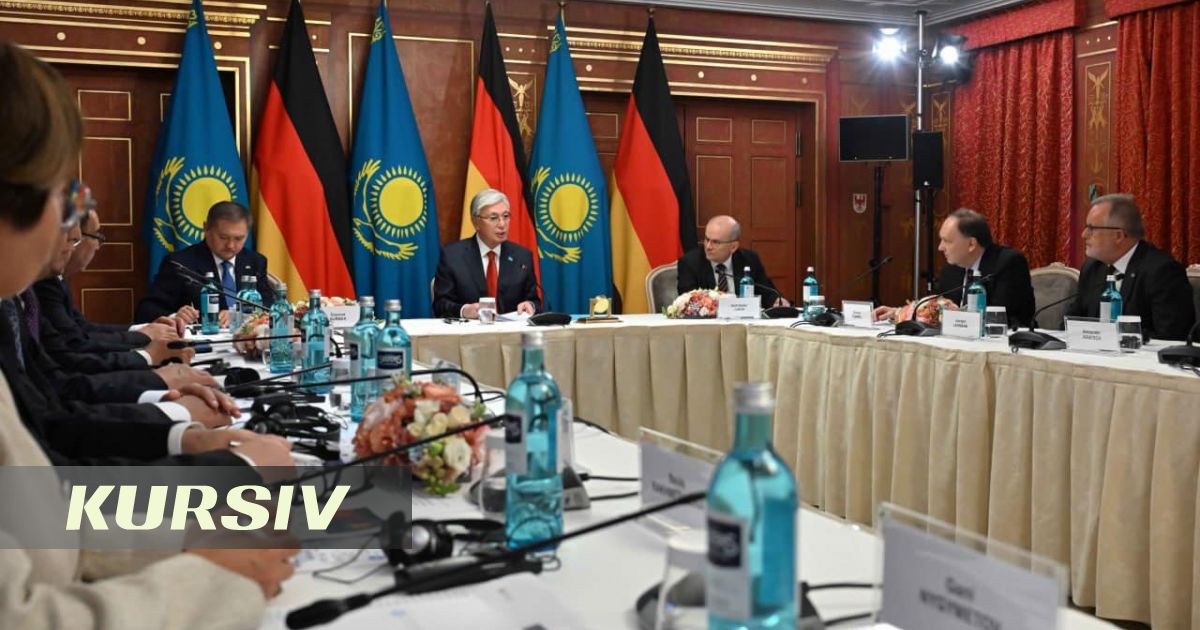
President of Kazakhstan Qasym-Jomart Toqaev, speaking in Berlin at a meeting with rectors of leading German universities, announced plans to increase funding for scientific research in the country to 1% of GDP, infohub.kz reports.
The head of state placed particular emphasis on artificial intelligence, which he said opens prospects for taking bilateral cooperation to a qualitatively new level.
Toqaev listed Kazakhstan's achievements in this area: the launch of the alem.cloud supercomputer cluster, the AI-Sana artificial intelligence training program, and the opening of a specialized research university. He invited German companies to consider Kazakhstan as a testing ground for Industry 4.0 technologies.
"Under the AI-Sana program, more than 700,000 students have acquired certified AI skills. We have deployed the alem.cloud supercomputer cluster, opened a specialized research university in this field, and adopted one of the region's first AI laws. All these efforts are complemented by advanced supercomputing technologies. This creates new opportunities for cooperation with German scientific institutions and industry. Our young, technology-oriented generation can become a reliable partner for German companies and researchers. Kazakhstan, in turn, can provide a platform for testing applied digital solutions and Industry 4.0 technologies," he emphasized.
The president separately noted the historical connection between Kazakh and German intellectual traditions, recalling that the great Kazakh poet and thinker Abai Qunanbaiuly translated Johann Wolfgang von Goethe's poem "Wanderer's Night Song" into Kazakh. According to him, this translation became one of the first intellectual bridges between the two peoples.
In conclusion, the head of state called on the leaders of leading universities and research institutes of Germany and Kazakhstan to combine the potential of the two countries to implement new projects.
Earlier, Kursiv wrote that Toqaev advocated educational exchange with Germany.
The head of Kazakhstan also identified three main areas for deepening the partnership:
Academic exchange and degrees: expanding joint educational programs and dual-degree programs, as well as creating conditions for joint work of students and researchers.
Linking science and industry: moving from a raw-materials model to high technology. An example is the TiBeRIUM project (development of low-carbon chains for titanium and beryllium) involving EKTU, the Ulba Metallurgical Plant, and the Freiberg Mining Academy.
Technology transfer: Toqaev urged German businesses to open engineering laboratories and technology transfer centers at joint institutions, promising state co-financing.