

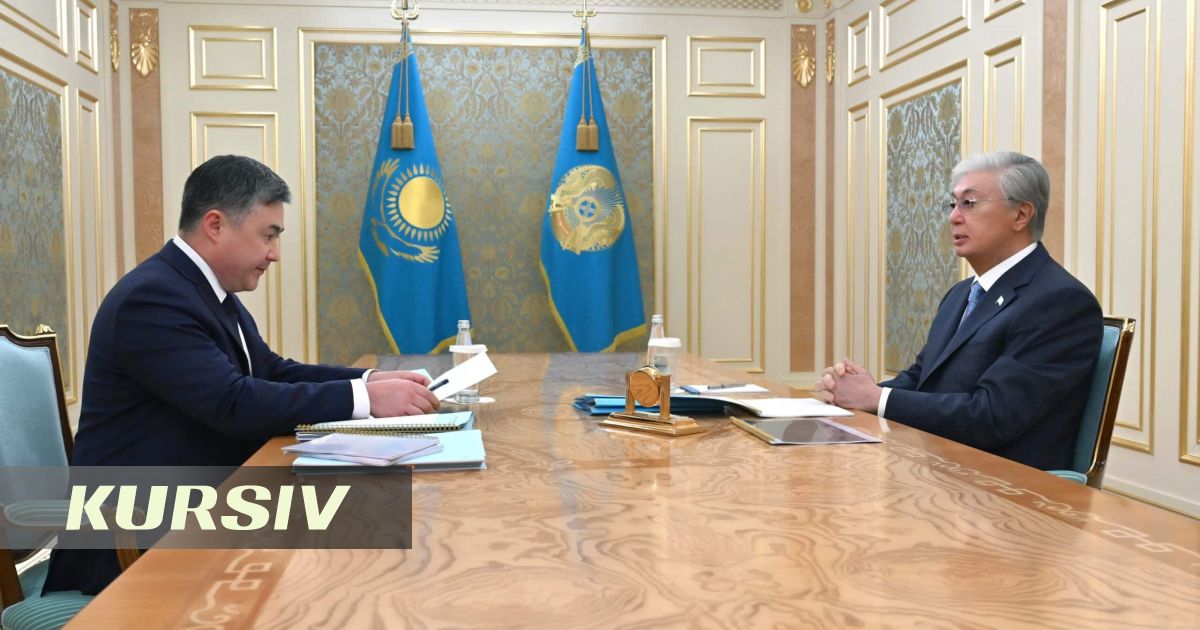
President of Kazakhstan Kassym-Jomart Tokayev has heard a report from National Bank Chairman Timur Suleimenov on the results of monetary policy for January-July 2026, reports infohub.kz.
The head of state was briefed on the economic situation, business activity, inflation factors, and measures to stabilize prices. According to the National Bank, annual inflation has been declining for ten consecutive months and stood at 10.2% in July.
The Akorda presidential residence noted that this was facilitated by the ongoing monetary policy, the strengthening of the tenge exchange rate, stabilization of consumer activity, as well as joint anti-inflationary measures by the government and the National Bank.
Tokayev was also briefed on the dynamics of lending to the economy. The banks' loan portfolio for business loans as of July 1 grew by 17.1% year-on-year, while lending to small and medium-sized businesses accelerated to 29.6%.
At the same time, consumer lending growth slowed from 21% at the beginning of the year to 13%. The Akorda attributed this to the effect of prudential measures and the normalization of consumer lending rates. As a result, credit resources are being redistributed in favor of business financing.
The President was also presented with data on the foreign exchange market, assets of the National Fund and the Unified Accumulative Pension Fund (UAPF), as well as the country's gold and foreign exchange reserves. As of July 1, the combined volume of the National Fund and gold and foreign exchange reserves amounted to $127.3 billion.
The investment income of the National Fund for the first half of the year reached $2.3 billion. Pension assets of the UAPF amounted to 27.8 trillion tenge, increasing by 1.7 trillion tenge since the beginning of the year.
Separately, the development of the Alatau City financial ecosystem was discussed. The National Bank has developed measures aimed at accelerating and simplifying capital flows, as well as attracting investment in the city's development.
Tokayev was also briefed on the implementation of instructions in the field of digital financial assets and the National Digital Financial Infrastructure. New areas include the use of stablecoins for cross-border payments, the development of corresponding infrastructure, and the issuance of tokenized government assets.
In addition, a new segment has emerged in the payment market: licensed payment organizations of the first category. According to the Akorda, this should increase competition, reduce customer costs, and expand access to digital financial services for the population and businesses.
Since July 19, QR payments and transfers by phone number between clients of any banks have been operating within the National Payment System. Since launch, 6.5 million transactions worth 170 billion tenge have been processed.
"The National Bank is taking all necessary measures to ensure price stability and achieve the medium-term inflation target of 5%," Suleimenov said.
Following the meeting, Tokayev set a number of tasks for the National Bank and emphasized the importance of further reducing and stabilizing inflation.
Earlier, Kursiv reported that annual inflation in Kazakhstan in July slowed from 10.3% to 10.2%, and prices rose by 0.6% over the month, compared to 0.8% in June. According to the Bureau of National Statistics, the dynamics were partly influenced by the seasonal decline in prices for vegetables and fruits.