

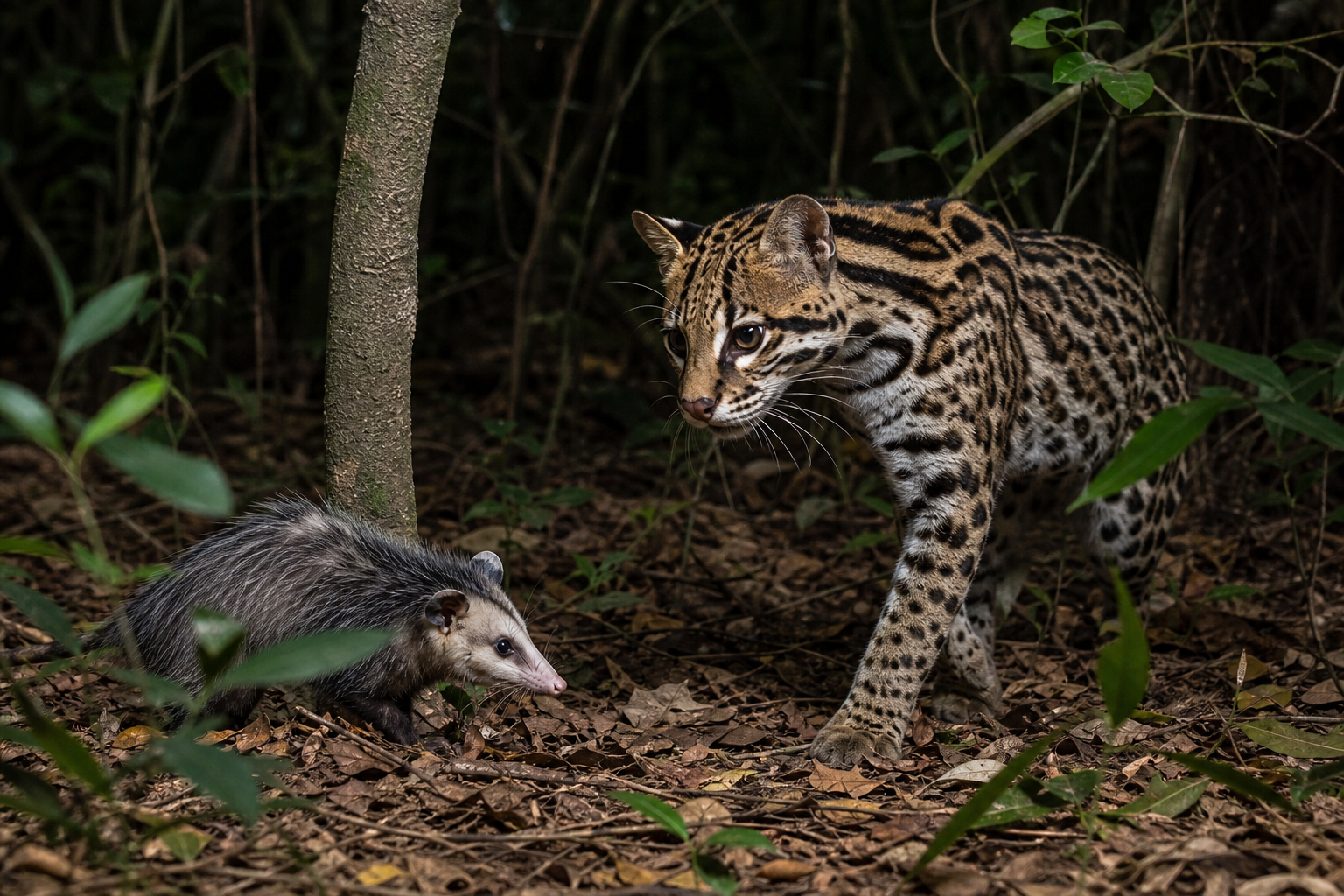
In the dense forests of the Amazon, scientists have recorded unusual animal behavior that defies conventional understanding of predator-prey relationships. Instead of chasing and attacking, researchers observed a calm, joint movement of an ocelot and an opossum. The unexpected finding has already sparked considerable interest among experts trying to uncover the reasons behind this peculiar behavior, reports infohub.kz.
The unusual scene was captured by a camera trap that was set up not for observing large mammals, but for studying birds. In the first frames, the ocelot followed the opossum, leading researchers to assume they were witnessing a typical hunt. However, subsequent footage completely changed that initial hypothesis.
"Instead of attacking or attempting to catch its prey, the camera recorded the animals moving calmly together. The ocelot and opossum appeared relaxed and behaved as if they were simply accompanying each other during a walk through the forest," the zoologists said.
This was not an isolated incident. Scientists recorded similar encounters three times between 2019 and 2023. The recurrence of these episodes prompted researchers to consider that there might be an as-yet-unknown form of interaction between the animals.
To understand the reasons behind the unusual behavior, specialists conducted an additional experiment. They placed fabric strips soaked with the scents of various predators in the forest. Then they observed which strips attracted the opossums.
"The results were quite unexpected. Opossums actively responded to the scent of the ocelot, while fabric with the scent of a puma barely attracted them. During the entire observation period, the animals visited the puma-scented strip only once," the scientists noted.
The data allowed researchers to propose several possible explanations. According to one hypothesis, opossums might use the ocelot's scent as a form of defense against larger and more dangerous predators. If an animal smells like an ocelot, other predators might avoid it. There is also a reverse version: perhaps ocelots themselves benefit from such proximity; for example, the scent of scavengers might help them remain less noticeable to their main prey, increasing hunting efficiency. Another hypothesis suggests that opossums may leave carrion behind, thereby attracting ocelots to potential food sources. This version is particularly intriguing because opossums usually live solitary and secretive lives, being active mainly at night.
None of the hypotheses has been confirmed yet. Researchers believe that new animal observation technologies could provide the answer. In particular, the development of night-vision surveillance systems will allow collecting more data and better understanding why a predator and its potential prey sometimes prefer not to conflict but to coexist peacefully.