

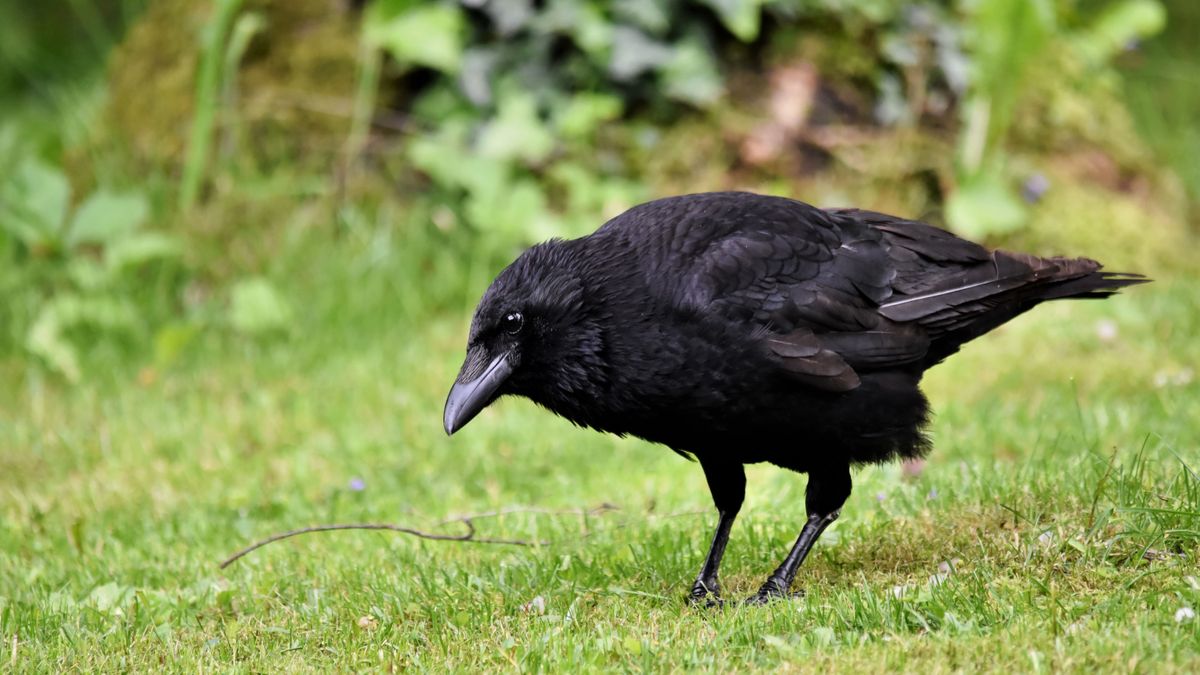
American crows living in cities allow humans to approach more closely than their rural counterparts, but they react more cautiously to unfamiliar objects near food, according to a study by Binghamton University biologists Dave Colucci and Anne Clark published in the journal Behavioral Ecology, infohub.kz reports.
The researchers observed American crows in New York State and the Canadian province of Quebec. They ran experiments with 20 crow families: half lived in parking lots and parks in the city of Ithaca, the other half on farms in nearby Dryden.
In the first experiment, the researchers set out peanuts with one of four objects placed in the center of each pile: a stone, an ear of corn, a takeout food box or a lamp base. When the unfamiliar lamp housing lay nearby, 76% of rural crows took the food, compared with only 53% of urban birds. Biologists call this fear of new things neophobia. The birds were calmer about objects familiar to their environment: rural crows were more often startled by the box, while urban crows were more often startled by the corn.
In the second experiment, Colucci walked toward the birds 145 times. On average, the crows flew off when the person was about 45 meters away. In cities, the birds let the researcher get closer, especially when he lowered his gaze to the ground — in that case the distance shrank by roughly another 25 meters. Rural crows, by contrast, flew off from a distance and paid no attention to the direction of his gaze.
The authors attribute this to the fact that hunting these birds is permitted outside the city, so they prefer not to take risks when a human appears.