

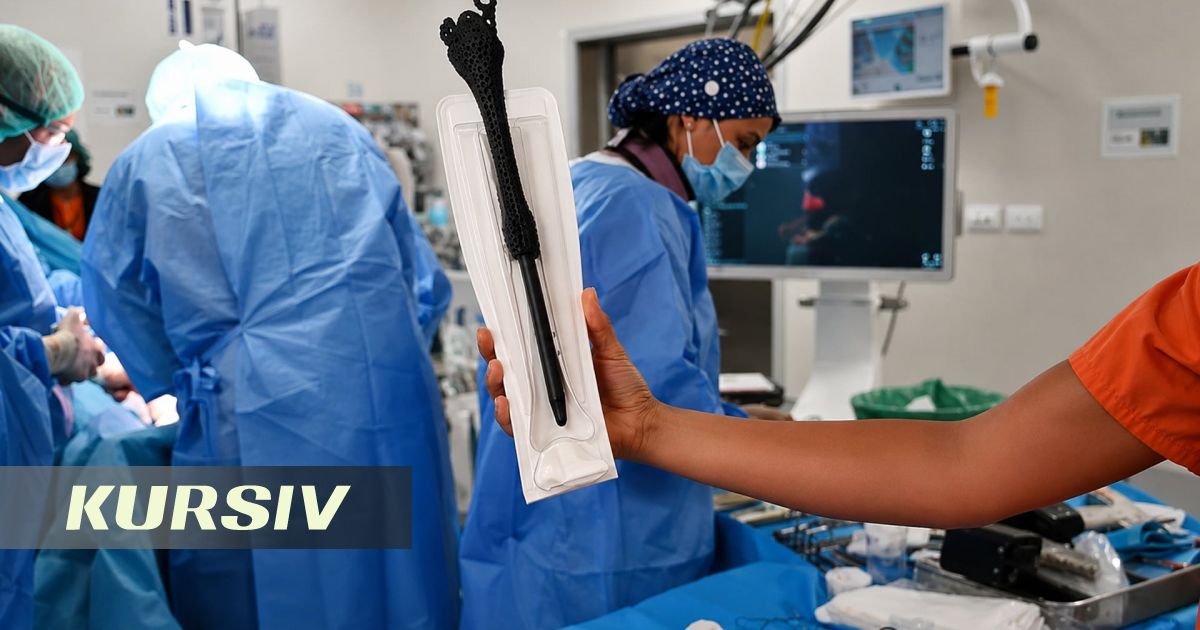
In Madrid, a 38-year-old patient with sarcoma of the tibia has had his leg saved thanks to a custom-made implant created with 3D printing, reports infohub.kz.
The patient, named Pierre Chazelle, was diagnosed with a highly malignant sarcoma of the tibia. After the disease and infection, the bone tissue was severely damaged and could no longer reliably support a standard implant.
Doctors decided to create a prosthesis specifically tailored to the patient's anatomy. First, specialists built a digital model of the patient's leg. Then they calculated the loads the bone experiences during walking, climbing stairs, and other movements. Based on this data, they designed a custom structure.
The technology is called a metamaterial. The properties of such a material are determined not only by its composition but also by its specially engineered internal structure.
Instead of a solid metal part, the implant is a lattice of titanium microstructures. This design replicates the shape of the removed bone and the principle of load distribution within the bone tissue.
This is important not only for strength. Thanks to the porous structure, the patient's own bone tissue can gradually grow into the implant, helping it to integrate better into the body.
According to the hospital, the implant weighs about 300 grams. Computer modeling showed that the structure can withstand loads of more than 500 kilograms.
For comparison, traditional bone prostheses can weigh several kilograms and are usually designed for lower loads.
The implant replaced the damaged section of the tibia, and doctors were able to save the leg and knee joint. Thus, the patient avoided amputation.
About a year has passed since the operation, and the man can now walk. Before that, he had been unable to put weight on his leg for nearly two years.
The sarcoma patient's case was the first such use of the technology in the hospital. Since then, specialists have already performed a second operation using a custom implant.
The team is now preparing two more implants — for the wrist and the sternum.
This is still a very early experience with the technology. More time is needed to assess its durability and safety.