

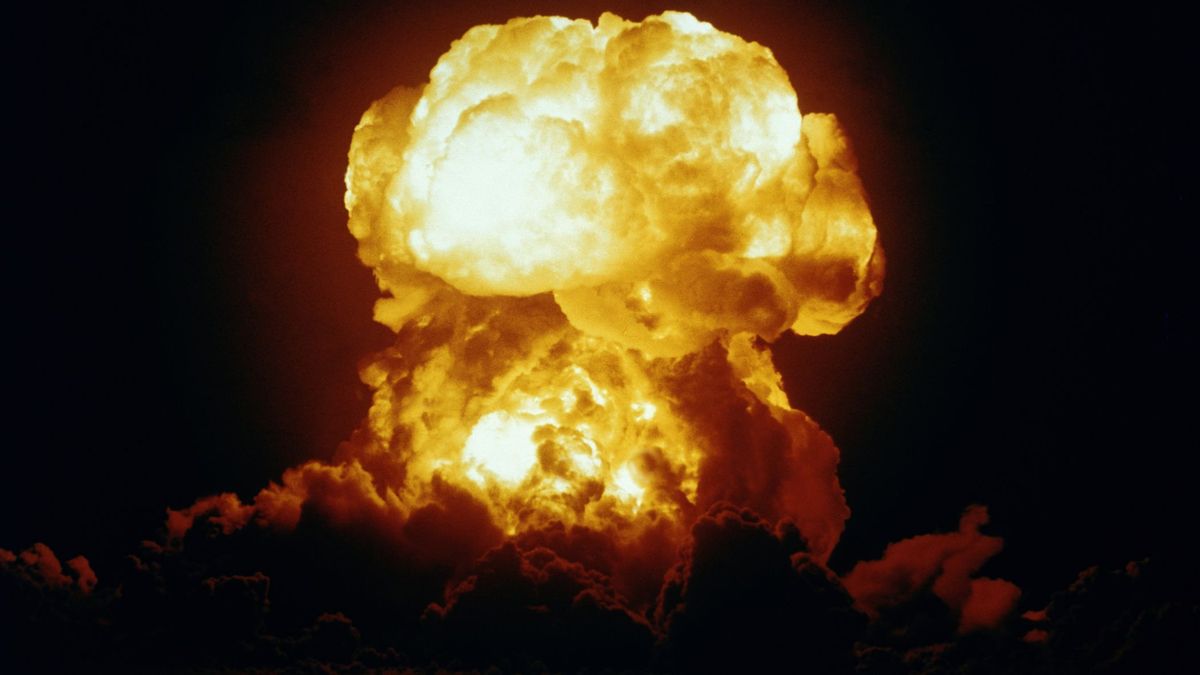
A single nuclear explosion in space could knock out 99.4% of satellites in low Earth orbit in just 15 days, according to researchers at the University of Wisconsin-Madison and Princeton University, who published a preprint of their study on the arXiv server, the website infohub.kz reports.
The researchers modeled the consequences of detonating a 1-megaton nuclear warhead at an altitude of 500 kilometers over the South Atlantic, where more than 13,300 active spacecraft provide communications, internet and weather forecasting services. The science portal ScienceAlert reported on the findings.
According to calculations by the team led by Zach Petersen, a blast in the South Atlantic Anomaly, where Earth's magnetic field is weakened, would create an artificial radiation belt of trapped radioactive particles. As satellites pass through this zone, they would receive critical radiation doses: 25% would fail within a day, 78% by the end of the third day, 98% after a week and 99.4% by the 15th day. Even with enhanced radiation shielding, 99.3% of satellites would be lost within a month. With a less powerful 100-kiloton warhead, the process would take about a year.
The authors recalled the 1962 Starfish Prime test, when a 1.4-megaton explosion at an altitude of 400 kilometers over the Pacific Ocean disabled several spacecraft and led to the signing of a treaty banning nuclear weapons tests in space. Today, the loss of satellite control would also trigger a chain reaction of collisions — about 20 accidents would occur over two years, and roughly 3,900 new pieces of space debris would form in orbit over ten years, blocking the launch of new spacecraft for years.