

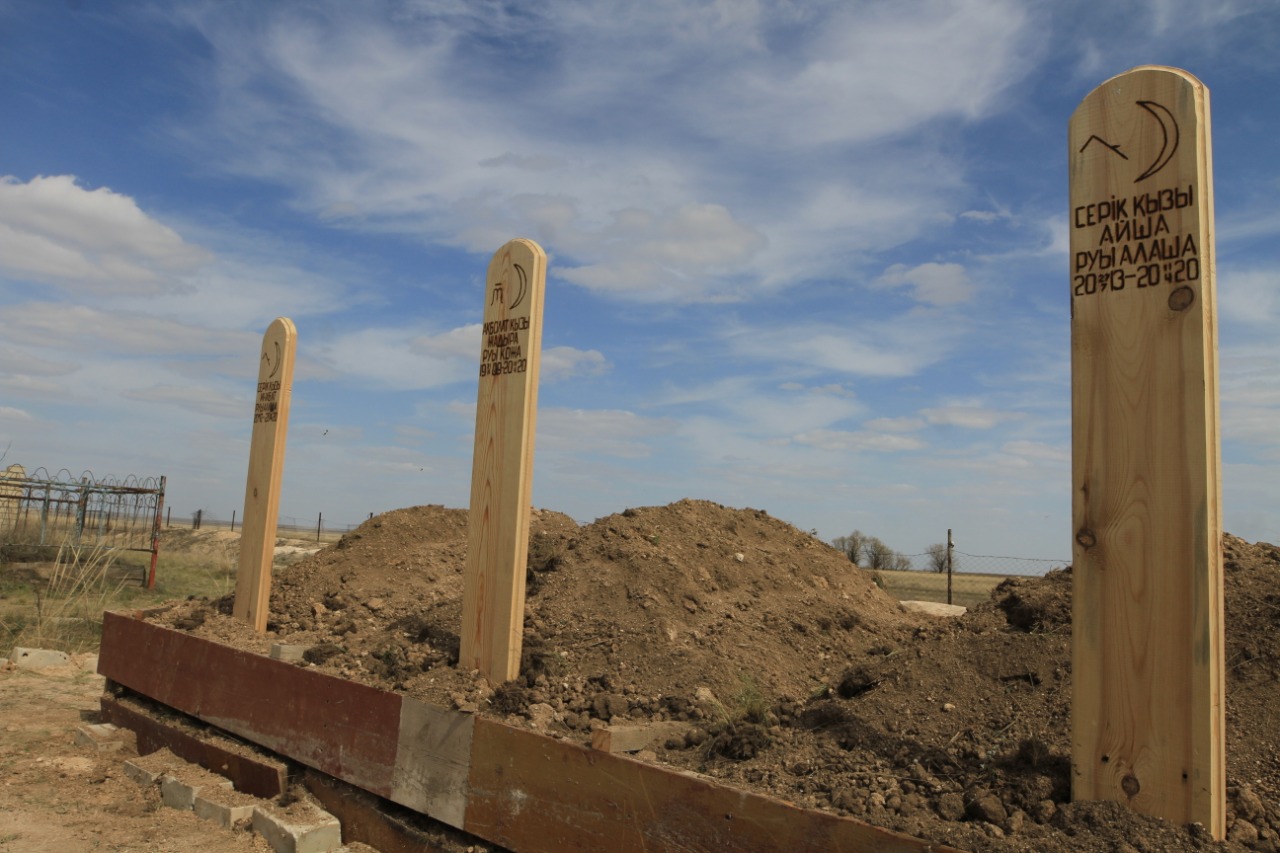
On April 11, 2020, in the village of Aktau in the Taskalinsky district, 30-year-old Zhadyra Zhumaliyeva and her two daughters, 8-year-old Inabat and 6-year-old Aisha, were buried. Their charred bodies were discovered in the ruins of their home after a fire on the night of April 8-9. Police arrested Serik Kafizov, Zhadyra's husband and the biological father of the girls, on suspicion of arson. The village has been rife with debate over what drove Serik to kill his family, reports the website infohub.kz.
In a school notebook, in a child's uneven handwriting, a last entry reads: "April 8. Classwork. Today the weather is cloudy. The sun is not in the sky." That same evening, around 10 p.m., Inabat, her sister Aisha, and their mother Zhadyra left their grandfather's house and walked the 300 meters to their own home on the same street, Suleimenova. Four hours later, at about 1:15 a.m., a young woman across the street saw Zhadyra's house ablaze.
By the time the first fire truck arrived, the burning roof had collapsed inward. Firefighters fully extinguished the flames after 3 a.m. A crowd of locals gathered in front of the house. As firefighters began clearing the debris, someone shouted that two badly burned bodies had been found — an adult and a child. They were Zhadyra and her older daughter Inabat. Minutes later, firefighters discovered a third body, a child, in another room, wedged between the wall and a stove. It was the youngest, Aisha, who apparently tried to escape the fire there.
"Everyone expected the firefighters to say they'd found another body — Serik's. But when they cleared all the rubble, it was clear Serik wasn't in the burning house," said Damir, a local resident.
Serik was found nearly six hours later, at dawn. He was walking across the steppe toward a neighboring village, wearing a bloody T-shirt. Blood had caked on his neck and chest. According to one version, he had either tried to slit his own throat or someone had stabbed him in the neck. The wound was not serious. He was taken to a hospital, where the wound was stitched. On the morning of April 11, as his daughters and wife were being buried, a court ordered Serik Kafizov's arrest on suspicion of murdering two or more people.
At the edge of the village cemetery, three kilometers from Aktau, a fresh grave mound rises, with three roughly planed boards bearing the names and dates of death of Zhadyra, Aisha, and Inabat. Zhadyra lies in the middle, her daughters on either side. All three boards share the same date of death.
Those at the funeral say that when the three wrapped shrouds were carried out of the house, it was quiet at first. But when the two small bodies were placed beside Zhadyra's on the bier, the women's weeping was joined by a murmur of men's voices.
Back at the house of Zhadyra's parents, where the funeral was held, people continued to arrive. Inside, the women's memorial meal was ending. Men gathered in small groups outside the open gate. Several young men, about the same age as the detained Serik Kafizov, asked who we were. Upon learning we were journalists, they challenged us: "What do you want?" — "To talk to Zhadyra's family." — "You don't need to talk to them," one said. "What do you think? Why do you think Serik did this?" I asked. "Hell if I know. He always carried a knife and if anything bothered him, he'd attack everyone with it," the young man in a tracksuit replied, then turned away, signaling the conversation was over.
We waited. The men exchanged short phrases, all revolving around the event. There was no open condemnation of what Serik had done. Many of them, it seemed, had interacted with him — helping butcher livestock, driving for hay, giving rides to the district center or city, or drinking together. We patiently waited for the women to come out so we could speak with Zhaniya, Zhadyra's aunt, the only relative who had been insisting for months that Zhadyra divorce Serik. Zhadyra had confided in her aunt, not wanting to upset her parents, and sought her protection.
Zhaniya agreed to talk immediately, stressing that this tragedy must be brought "to the very top."
"When I got a call in the middle of the night that Zhadyra's house was on fire, I was sure Serik had set it. I also believed no one would be found inside. While firefighters fought the blaze, I drove with police toward an abandoned farm, hoping Serik had taken Zhadyra there to beat her. When they called and said they'd found the bodies of Zhadyra and the children, I felt everything inside me collapse. Only a fierce desire to find Serik remained," Zhaniya recounted.
Zhaniya herself is a former police officer, retired three years ago, having worked in juvenile affairs and as an investigator. Three years ago, she learned from Zhadyra that Serik had brutally beaten her.
"He drove her to an abandoned farm, beat her severely, then chased her around a field in his car for about an hour. When she collapsed, he dragged her back into the car and took her home. That was the first time she told me he was constantly abusing her. I insisted she file a report. The problem was that she told me a week after that horrible night. The bruises had faded, making it hard to prove. Still, she filed a complaint. Then Serik's relatives and friends started showing up at her parents' house. Both Zhadyra and I were foolish — we forgave him. The case was dropped due to reconciliation. I scolded her, but it wasn't just his relatives; her own parents also said it was a family matter and that she should preserve the family for the children's sake. They got back together," Zhaniya said.
Once back together, Serik resumed periodic beatings, but Zhadyra stopped complaining. Zhaniya believes she felt ashamed after forgiving him. But this time, Zhaniya began regularly calling her niece to check on her relationship.
"I once saw a scratch on her cheekbone. I pressed her: 'Serik is hitting you, isn't he?' She said a cow butted her. Later she admitted he had beaten her several times. I scolded her and told her not to hide anything and to call me immediately next time," Zhaniya said.
The next time came soon. On February 29, 2020, Serik and Zhadyra went to a restaurant in the district center for a relative's anniversary. Serik got drunk and fought with another guest. Zhadyra called a taxi and went home. Her mother-in-law, knowing her son's temper, told Zhadyra to sleep at her parents' house.
"At 5:30 a.m., Serik arrived at his father-in-law's house, broke down two locked doors, grabbed Zhadyra by the hair, and slammed her head against the wall. Then he dragged her outside, put her in his car, and drove off. Zhadyra's mother (her father wasn't home) ran after the car and called me. I immediately called the police. Serik drove to his own house and held Zhadyra in the car for over an hour. The neighborhood police officer arrived an hour and a half later with two community assistants. At that moment, Zhadyra managed to jump out of the car and run to me," Zhaniya said.
During that time, Serik not only held her but also tortured her with a stun gun. About ten marks from the stun gun were counted on her arm and chest. Zhadyra filed a police report. But Serik was only charged with minor administrative offenses — causing light bodily harm and illegal entry into a home. No mention of torture or unlawful detention. The case went to court. The prosecutor sought 10 days' arrest, but the judge gave Serik only five, considering his clean administrative record.
"On the first day of his arrest, Serik called Zhadyra on her cell phone, first threatening her, then begging forgiveness. When I found out, I called the police and demanded to know how an administrative detainee had a phone. That evening, police officers came, apologized, and said someone had made a mistake. After five days, Serik left for a work shift. Zhadyra filed for divorce. Then the delegations from Serik started again — relatives, drinking buddies, and even local farm managers Askar Maltiyev and Berik Temirbekov. They all begged Zhadyra to forgive Serik and withdraw the divorce petition, spouting nonsense about 'what people would say' and 'preserving the family for the daughters.' And none of those petitioners showed up at the funeral today. On April 3, Serik came to her parents' house, begged for forgiveness, and promised never to touch her again. Zhadyra firmly said no and told him she wouldn't live with him. Then, standing before her parents and his own mother, Serik said: 'Don't think you'll get rid of me. I'll burn you,'" Zhaniya recounted.
Now the deaths of Zhadyra and her daughters dominate conversation in Aktau. A few residents recalled that two days before the fire, someone saw Serik walking around asking drivers for gasoline in a canister. Others say he went to the district center and bought five liters at a gas station. Almost everyone wonders whether he knew the children were inside when he set the fire. Only Zhaniya asks: what did Serik do to Zhadyra that she couldn't save her children?
"The forensic examination couldn't determine if she had any pre-existing injuries because of the charring. It says 'cause of death undetermined due to carbonization.' But let's think logically. Fire doesn't kill instantly. If she had been conscious, she would have had at least two or three minutes to break windows and push the girls out. She didn't. Her body was found on the living room floor. That means Serik first beat her unconscious and then set the fire. I'm sure he doused her and the house with gasoline, because it all caught fire too quickly and throughout the house. And he knew the girls were there. He knew they were alive and would burn to death," Zhaniya said.
We spoke with Zhaniya an hour after the funeral. From where we stood, we could see the remains of Zhadyra's house.
"In an investigation, there's a procedure where the suspect is taken to the crime scene to verify his testimony. I will insist they do that with Serik. Let him see with his own eyes where they found all three bodies. Let them show him: 'Here we found Zhadyra and Inabat, and here little Aisha.' Let him imagine how the girls died in the fire, and let that haunt him for the rest of his days," Zhaniya said.
Before visiting Aktau, I had imagined Zhadyra as a downtrodden woman without ambitions. But the last few months of her life had brought big changes. During 10 years of marriage, Serik had forbidden her from working. Neighbors said she ran the household alone — keeping five cows and about a dozen sheep, selling milk, sour cream, and butter. Everyone we spoke with asked: "Did you see their house?" Looking at the property, it was clear there was no man's touch.
Last September, Zhadyra got a job as a librarian at the local school. The principal, Bayan Irgaliyeva, said Zhadyra threw herself into the work from day one.
"I've worked in rural schools for years. When Zhadyra started, I worried I'd have to teach her everything, given the many education reforms. But she came prepared — with a laptop and strong computer skills. She was well-groomed and strict, as if she'd always been a teacher. In that short time, she proved reliable, hardworking, and sociable. Students and colleagues loved her. District education officials also praised her. She planned every extracurricular event meticulously, as if she had years of experience. And she did it all without much guidance. Zhadyra was an excellent mother; her girls were always neat and tidy, excellent students active in class. When I learned she also ran a farm, I was amazed at her energy. Not every woman can handle such a load — tending livestock, maintaining a house, caring for children, and excelling at work," Bayan Irgaliyeva said.
After the tragedy, Bayan admitted she only recently learned about Zhadyra's family problems. Had she known earlier, she could have tried to intervene or mobilize the community.
"But someone else's family is a dark place; you don't know what goes on behind closed doors. Zhadyra never asked for time off for chores, unlike many rural women. But when it came to social events with colleagues, she always declined, saying her husband wouldn't allow it. That always signals something wrong in a family. I've had cases where I had to 'educate' such husbands, explaining that their wives should participate in public life. But with Zhadyra, I didn't get the chance," Bayan said.
I asked Zhaniya if Zhadyra had any friends.
"No. You'd be surprised, but her phone had no contacts except relatives and colleagues. She didn't even save contacts of classmates. At the funeral, her classmates said they had stopped inviting her to meetings or birthdays because they knew her husband wouldn't let her go. Shortly before her death, Zhadyra told me she cleared her call log daily because Serik would check her phone and start a fight if he saw an unfamiliar saved number. She had no Instagram or other apps — only calls and WhatsApp, used solely for family and work. That was her life," Zhaniya said.
Now Zhaniya and her colleagues ask whether the tragedy could have been prevented. At the funeral, Serik's sisters and aunts reproached Zhaniya, saying if she hadn't interfered, the crime might not have happened. Zhaniya herself believes everyone, without exception, became Serik's accomplices. She regrets not insisting on a divorce three years ago, instead facilitating their reunion for the sake of the girls.
"I don't blame myself for insisting on the divorce. But I do blame myself for not intervening earlier, for not pushing for their divorce three years ago. Neighbors knew what was happening. Relatives knew. Serik's friends and brothers knew he beat her. She told colleagues, apparently. The local police officer knew. The village mayor could have intervened. But that night, none of us were there for Zhadyra. We all had a hand in this," Zhaniya said with absolute conviction. "The village mayor, officials from the district's Nur Otan party, and a female deputy from the district maslikhat came to the funeral. I reminded them that last year the district akimat asked me to participate in a roundtable on domestic violence. It was a good roundtable — we discussed important things. But there were no results, no follow-up. It was just for show. That's what I told them. I want to raise this issue now because the worst part isn't just that Zhadyra and her girls burned in that house. The terrible truth is that right now, in this same village, there are dozens of women being beaten by their husbands. In the district, there are such women. And they all stay silent. Everyone around them stays silent. And they will stay silent until another Serik stabs his wife or burns her with her children. And then everyone will come to the funeral and say, 'But we didn't know. Who could have guessed?'"
We wanted to ask the village mayor and the local police officer whether the murder could have been prevented. The mayor was in a hurry and said he knew nothing about the abuse. The police officer was unavailable — either on sick leave or on a business trip.
The local authorities' attitude toward the tragedy is evident from the mayor's Facebook page. There is no mention of the event. The last post, from March 10, shows a photo of Nursultan Nazarbayev and an obscure text about coronavirus. More telling is the akimat's page from March 18, which reports that the mayor of Belgyn village and police officer Gubashev toured all settlements in the rural district, meeting with residents and inquiring about their lives. The post is accompanied by 13 photos — only one shows a female resident; the rest feature the mayor and police officer with men.
Outside Zhadyra's parents' house, we met Tolegen, a distant relative who organized the grave-digging crew. After we photographed the graves, Tolegen led us through the cemetery.
"Here lies my cousin. He hanged himself. This is my age-mate; he also committed suicide," Tolegen said, walking through the cemetery like a family album. The gravestones showed faces of young people. He counted three graves of people who had taken their own lives before age 30. Adding local boys who died in fights or car accidents, there were eight graves of young people — a high number for a village of just over a hundred houses.
As if answering my unspoken question, Tolegen offered a brief explanation: "It's all from vodka. And from hopelessness."