

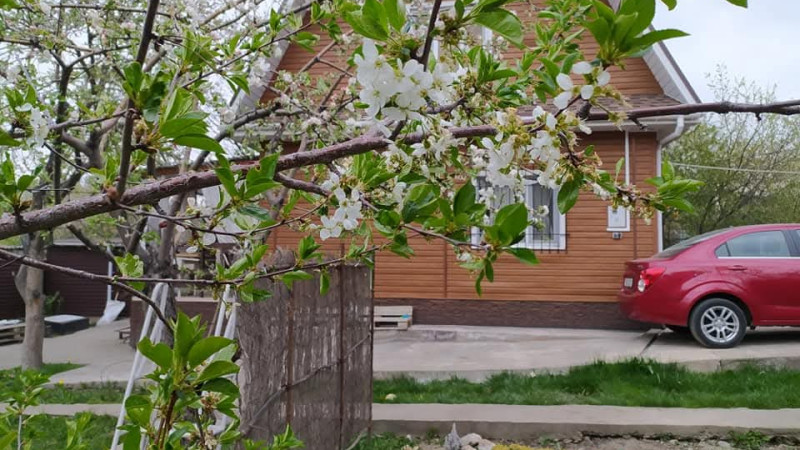
A few years ago, dachas were rarely seen as profitable real estate, but over the last five years the situation has changed dramatically: a standard six-sotka plot (0.15 acres) has evolved from a seasonal vegetable garden into a sought-after suburban home. Some buy them for permanent residence, others for business, reports the website infohub.kz.
According to Alexander Vainshtok, chairman of the ethics and membership committee of the United Association of Realtors of Kazakhstan, demand for dachas has come in waves. The first wave occurred in the early 2000s, when Almaty expanded its borders, incorporating dacha communities into the Kensai, Kazakfilm, Gorny Gigant, and Baganashel areas — now part of the Medeu and Bostandyk districts. Utilities were installed there, and six-sotka plots became attractive for cottage construction.
The second wave, in the expert's view, began after the pandemic: emerging from lockdown, Kazakhs actively bought dachas as an affordable option with a plot and fresh air. The third surge of demand came in late 2021 – early 2022, when excess pension savings were used and preferential mortgage programs were in effect. This drove up urban housing and private home prices, and buyers switched to dachas. The fourth wave, according to top-category realtor Alexander Biketov, occurred in 2024 after a noticeable earthquake in Almaty — residents of high-rises sought to move closer to the ground, though the effect was short-lived.
Overall, from 2020 to 2026, dacha prices in the Almaty region rose three- to fourfold, and experts predict further growth. Realtors note that high-quality dachas with all utilities will compete with apartments and private homes. Reasons for their popularity include a lifestyle with a yard, bathhouse, and barbecue area, remote work, the desire to leave overcrowded cities, and affordable prices — for the cost of a small apartment, one can buy a plot with a house.
There is no separate statistics for dacha transactions, but analysis of listings on a popular real estate portal shows: the portal features 6,098 dacha listings, accounting for 6.6% of the total. In Almaty — 420 (3.7%), in Astana — 85 (4.2%), in Shymkent — 285 (4%), in the Almaty region — 1,200 (7.3%). However, actual supply is higher, as dachas are often sold without listings — through cooperative chairpersons or signs on gates. Prices vary: from 2–7 million tenge for simple summer cottages to tens of millions for permanent structures, and in premium Almaty locations, over 100 million tenge.
In Almaty and the region, the most affordable options (farther from the city, no gas, seasonal water) cost 5–15 million tenge, the mid-range — 15–35 million, and expensive properties with renovations and utilities — 35–70 million and up. The most expensive dachas are in the foothills. Popular directions include communities near the villages of Turar, Issyk, and the town of Kaskelen. The priciest properties are in the Medeu and Bostandyk districts. Plots without houses can be found from 1.5 million tenge in the region and from 3.5 million in the mountainous areas of Almaty. For a plot with water and electricity, an additional 3–4 million tenge is needed; with gas, another 1 million. The shape of the plot also affects price: sloped plots are cheaper, but permanent structures cannot be built if the slope exceeds 15%.
Renting dachas in Almaty and the region is not very common: the portal has only 16 listings within the city at prices from 70,000 to 700,000 tenge per month, and in the region from 50,000 to 500,000 tenge. Experts separately analyze the market of the city of Konayev: after it was granted the status of administrative center of the Almaty region in summer 2022, demand for dachas began to rise. However, the frenzy quickly subsided, and now buyers are more selective. The most liquid dachas cost 15–35 million tenge for a 6–10 sotka plot with a permanent house and utilities. Simple seasonal dachas — 7–15 million, high-quality ones with renovations and heating — 35–60 million.
In Astana, most dachas are located in the suburbs, but some have been incorporated into the city limits during expansion. According to realtor Anna Gridina, after the pandemic, dacha prices rose by 30–100% or more, and today they have stabilized but remain above pre-pandemic levels. Within the city, a dacha with a dilapidated structure costs from 10 million tenge, with a solid house from 30 million. In the suburbs, a bare plot can be found for 4 million, the mid-range is 7–15 million, and well-appointed dachas in developed communities reach 15–25 million. Renting dachas in the capital ranges from 50,000 to 250,000 tenge per month.
Dacha buyers can be divided into several categories: those using them for year-round living (pensioners, families with children, young families), for weekend getaways, for business (mini-farms, guesthouses, glamping), and as an investment. Demand exists, but many properties sit idle for years due to a number of issues: lack of registration (buildings have no residential status), difficulty changing land use designation, insufficient utilities (central water supply, sewerage, gas), poor infrastructure (no schools, hospitals, bad roads), security problems, incomplete paperwork (old state deeds, unauthorized constructions), and a new limit of 50 square meters for house size on dacha plots (introduced in June 2024).
Experts predict a further division of the dacha market into old seasonal and high-quality properties. The latter will rise in price and compete with private homes. Dachas may become more commonly rented out, as their per-square-meter cost is cheaper than city studio apartments. The main takeaway: buyers want a comfortable home with a plot, not just six sotka. Quality properties are transitioning from seasonal real estate to a full-fledged suburban housing segment.