

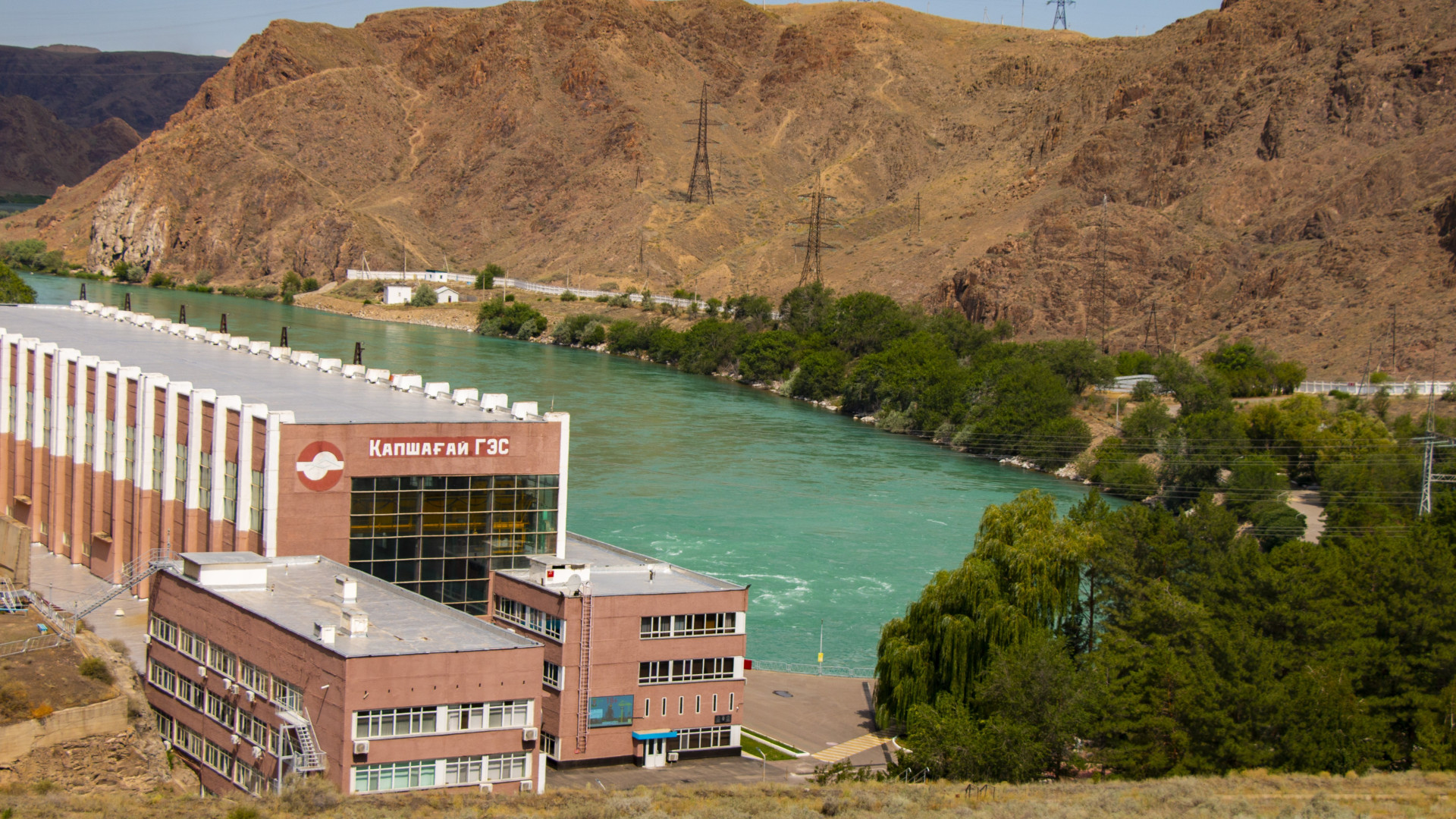
56 years ago, the first hydro unit at the Kapshagai Hydroelectric Plant was commissioned, and since then the station has generated about 60 billion kilowatt-hours. But few know that its employees not only monitor turbines but also breed fish in the reservoir. A Tengrinews correspondent explored how this unique energy facility is organized, reports infohub.kz.
The Shafik Chokin Kapshagai HPP is located in the Almaty region on the Ili River. Construction began in 1965, the first unit started at the end of 1970, and the plant was fully commissioned in 1980. Today, four hydro units operate with a total installed capacity of 364 MW. For comparison, the cascade of hydro plants on the Bolshaya Almatinka River has about 43.7 MW, and Almaty's TPP-2 has 510 MW.
The entrance to the HPP is just after the bridge across the reservoir on the Almaty–Ust-Kamenogorsk highway. But the main buildings are hidden behind a high fence, and the plant sits at the bottom of a hollow between two dams. It is a strategic facility, so access is strictly by pass.
Station director Alibek Tastanbekov emphasized the seriousness of the work: "There are risks in our job. We have a dam. In my office we are at an elevation of 449 meters. Today's water level in the Kapshagai reservoir is 477-478 meters, meaning the water behind the dam is 28-29 meters above us. If the dam gives way, we cannot stop that volume of water. Such situations have occurred – for example, at the Sayano-Shushenskaya HPP on the Yenisei River in Russia in 2009. Seventy-five people died. Those closer to the street managed to react. Those on the technical floors didn't – they were flooded and many drowned." All dams are equipped with sensors and under constant monitoring.
A unique feature is a rocky remnant connecting the two dams. Four water conduits over 100 meters long and 8 meters in diameter are cut through it. "That's about two and a half stories high. These conduits were blasted directly through the rock. It began in 1965. Each hydro unit has its own conduit," said Tastanbekov. The remnant requires constant concrete reinforcement because the rock deteriorates from external factors. Seepage monitoring sensors are installed.
The riverbed dam, over which the highway passes, is 470 meters long and 50 meters high. The valley dam is 370 meters long and 56 meters high. The rocky remnant is 460 meters long. Construction involved excavation of 4.649 million cubic meters of soil and rock, embankment of 2.796 million, hydraulic fill of 2.44 million, and placement of 229,000 cubic meters of concrete.
The water regime of the plant is regulated by the Balkhash-Alakol Basin Inspectorate. "At the beginning of the year, we receive a water use schedule. But it can always be adjusted because there is a note 'until further notice.' So we sometimes get updated data, like 'from such and such date, water release is allowed in these amounts,'" Tastanbekov said.
The design maximum water level in the reservoir was 485 meters, but it has never been reached since operation began. The upper limit was lowered to 479 meters. Due to insufficient head, the turbines were re-rated in 1993, reducing each unit's capacity from 91 MW to a total of 364 MW, meaning installed capacity dropped from 434 to 364 MW. Today's Konayev has grown, and raising the water level would flood coastal areas. Moreover, reservoir water is used for city water supply, irrigation, and maintaining Lake Balkhash's level.
On the day of the filming, water flow was 600 cubic meters per second with an hourly load of 175 MW. Two of four hydro units were operating, one on standby, and one under maintenance. The minimum permissible load per unit is 40 MW. In an emergency, water supply can be cut off by rapidly falling gates at the water intakes. Downstream, there are two emergency spillways.
Average annual output is about 1 billion kWh. Over 56 years, the plant has generated approximately 60 billion kWh. This year, due to low inflow, about 800 million kWh is expected. For comparison, one apartment consumes about 350 kWh per month. So the plant can supply roughly 240,000 apartments. "If we sent all our electricity in one direction, we could power a quarter of Almaty. Of course, we're only talking about residential areas. This electricity was enough for both Taldykorgan and Kapshagai – more than enough. But the main goal has always been to send cheap energy to the growing city of Almaty," said Tastanbekov.
The hydro units have been operating since launch, undergoing regular maintenance but never replaced. Modern sensors have been installed, digitizing data. Modernization is planned with replacement of runners and generators to return to the design capacity of 434 MW. Also in the pipeline is the construction of a counter-regulating Kerbulak HPP 20 kilometers downstream.
The staffing issue is acute: 55-60% of employees are pre-retirement age, and young people don't come due to low salaries and remoteness. Kazakhstan's universities do not offer a "hydropower" major – future specialists are trained in Russia. Of 12 students offered internships, all refused. Last year, they managed to hire three graduates from an energy institute, and this year, two more.
Chief engineer Maxim Mamyrin, who has worked at the plant since 2002, gave a tour. He explained the principle: water falls under pressure onto the turbine runner, spinning a shaft connected to a generator. Oil receivers supply oil to servomotors. The hydro units extend 20 meters deep. The rotor weighs over 400 tons; the hall has two cranes with a capacity of 250 tons each.
The main control room retains a 1970s atmosphere, but monitors and modern sensors have been added. All units are controlled from here. Four power transformers step up voltage to 220 kV and send it to an open switchyard. Two lines go to Almaty, two to Taldykorgan.
Despite the strict regime, the plant pays attention to ecology: trash screens, a grab for large debris, and a fish protection device with 74-76% efficiency are installed. Annually, about 3,000 juvenile fish are released into the reservoir.